

Species · Gallirex johnstoni
Rwenzori turaco
An Albertine Rift endemic that lives in exactly the forest people already travel to for gorillas, which makes it one of the easiest great birds in Africa to add to a trip you are taking anyway. Most visitors hear it long before they see it, and a good many never connect the barking in the canopy with the crimson flash that goes across the trail.
Checked 28 Sept 2026
- Where
- Albertine Rift endemic — four countries
- Best months
- Jun–Sep and Dec–Feb, for the trekking
- Altitude
- Mostly above 2,000 m
- Odds
- Heard often; seen well with patience
Montane forest of the Albertine Rift and nowhere else: eastern Democratic Republic of the Congo, south-western Uganda, Rwanda and Burundi. That is a narrow strip of high ground a few hundred kilometres long, and it is the reason a bird that is common where it occurs still matters.
Where it is
HabitatWet montane forest, bamboo and the upper forest edge, mostly between about 2,000 and 3,000 metres and locally higher. It follows fruiting trees through the year and moves through the canopy far more by running along branches than by flying.
Worth travelling for
The easiest country to see one in, because the two places that hold it are the two places most visitors already go. Volcanoes for the bamboo and Hagenia zone on a gorilla or golden monkey trek; Nyungwe for the serious birding.
Mgahinga's bamboo puts you in the right habitat on the same trek as the gorillas and the golden monkeys. The Rwenzori Mountains hold the nominate population and the best forest, at the cost of a multi-day trek to reach it properly.
Also occurs
DR CongoBurundi
Present, but not where you would go to see one.
Where to actually go
Ranked, with the reason each — these are not interchangeable.
- 01NyungweRwandaThe one park on this list built for birders, with guides who know the Albertine Rift endemics by call and trails that go through the right altitude band. If the bird is the reason for the trip, this is the answer.Ask for a birding guide
- 02VolcanoesRwandaBamboo and Hagenia forest on the gorilla and golden monkey treks, which is exactly the habitat. You are going anyway; the turaco is a matter of listening while you walk.Free, if you are trekking
- 03Mgahinga GorillaUgandaThe Ugandan side of the same Virunga bamboo, much quieter than Volcanoes and cheaper to trek in. Small park, good forest, and the golden monkey trek puts you in the canopy zone for an hour without hurrying.The quiet Virunga option
- 04Rwenzori MountainsUgandaThe mountains the bird is named after, holding the nominate population in bamboo and heather on the way up. A serious multi-day trek rather than a morning walk, and the forest is worth it for its own sake.For the mountains, not the odds
Where you will not see one
- Anywhere outside the Albertine RiftKenya, Tanzania, the Kenyan highlands, Ethiopia — none of them. The green turaco in the Aberdares is Hartlaub's, and the one at Ngorongoro's forest edge is Schalow's. This bird occurs in four countries and in a strip of mountains inside them.
- Lowland forestKibale, Budongo, Semuliki and the Bwindi lowland sector are too low. There you get black-billed and great blue turacos instead, which are excellent birds and are not this one.
- The savanna parksAkagera, Queen Elizabeth, Murchison. Turacos of some kind occur along riverine strips, but the Rwenzori turaco is a montane forest bird and will not be among them.
When to go
When to go
- J
- F
- M
- A
- M
- J
- J
- A
- S
- O
- N
- D
January: best. February: best. March: marginal. April: marginal. May: good. June: best. July: best. August: best. September: best. October: marginal. November: marginal. December: best.
Through the day
- Dawn
- Morning
- Midday
- Afternoon
- Dusk
- Night
Dawn: most active. Morning: most active. Midday: usually resting. Afternoon: active. Dusk: active. Night: not normally seen.
Realistic odds on a three-day trip
- Near-certain
- Likely
- Lucky
- Expedition
Telling it apart
Told apart from
Great blue turaco
Lower down the same mountains, and common at Nyungwe's lower trails
Enormous by comparison — the size of a small turkey — and blue-grey with a black crest and a yellow-and-red bill. If it is crashing through the canopy and everyone has already seen it, that is the great blue.
Black-billed turaco
Bwindi's lower sectors, Kibale, Budongo
Green like this bird, but with a black bill and bold white marks around the eye, and no crimson on the head. It replaces the Rwenzori turaco below about 2,000 metres, so altitude does most of the work.
Ross's turaco
Savanna riverine strips, never the high forest
Violet-blue all over with a tall crimson crest and a yellow bill. A riverine and woodland bird of lower country, not a montane forest one.
Marks chosen to be usable from a moving vehicle — a rwenzori turaco is rarely still and never close enough for anything subtler.
What it looks like in the field


Photographs of Rwenzori turaco in the wild, in Indian reserves. We publish no captive, baited or digitally composited images, and no photograph whose licence we cannot show.
Photographing it
- Lens
- 400mm and up, and accept that most frames will be through leaves. This is one of the few birds on the site where a fast lens matters more than a long one.
- Typical distance
- Ten to thirty metres, almost all of it steeply above you. Belly-up shots into a bright sky are the default problem.
- Light
- Montane forest is dark, wet and contrasty, and the bird is dark green in shade. Expect to work at high ISO, and treat any bird that comes to an open edge or a bare snag as the shot of the trip.
Where to stopNo playback in the gorilla parks, and think hard about it anywhere else — these are small endemic populations in heavily visited forest and the cumulative effect of every group calling birds in is not nothing. Stay on the trail and keep up with the trek; a stopped group in a gorilla park is a problem for the guides, not a birding opportunity.
Signs and calls
- Call
- The way this bird is found. A deep, hoarse, barking series — a repeated kow or caw that accelerates and often sets off a neighbouring bird answering across the valley. It carries a long way through wet forest and it is unmistakable once heard, which is why an hour of listening beats an hour of looking.
- Crimson flash
- A green bird disappears and a red one crosses the gap. The flight feathers are deep crimson and only show in flight, so a bird you never identified perched is often identifiable the moment it leaves.
- Running in the canopy
- Turacos are poor sustained fliers and superb climbers. Movement along a branch, squirrel-like, then a short heavy glide to the next tree, is the search pattern to look for rather than a bird flying past.
- Fruiting tree
- Dropped and half-eaten fruit under a canopy tree, with the branches above it busy. Find the tree that is in fruit and stand under it; that is the whole technique.
Where the colour comes from
Almost every green bird you have ever seen is not actually green. Bird plumage takes its blue and most of its green from microscopic structure — feather barbs scattering light — rather than from pigment, which is why a blue jay ground to powder is brown. Turacos are the exception, and they are the only family that is. They manufacture two copper-based pigments found nowhere else in the bird world: turacoverdin, which is a genuine green, and turacin, which is the crimson in the flight feathers.
For a visitor the practical consequence is the flash. A Rwenzori turaco perched in wet canopy is a dark green bird that is very hard to pick out and, given the chance, will simply run along a branch and vanish. The same bird crossing a gap between trees opens crimson wings and is unmistakable at fifty metres. If you are struggling to get a view, wait for it to move rather than trying to see it where it is.
The rest of it is worth knowing before you look: dark green body with a blue-purple wash to the wings and the long tail, a crimson crown behind a short crest, and a red bill. It is a fruit-eater that follows the fruiting calendar of its forest, so birds concentrate wherever a canopy tree is in fruit and are absent from stretches that look identical.
The bird on the gorilla trail
The single most useful thing to say about the Rwenzori turaco is that its habitat is the gorilla habitat. Bamboo and Hagenia forest between roughly 2,000 and 3,000 metres in the Virungas and the Rwenzoris is where the turacos are and where the gorilla and golden monkey treks go. Thousands of people walk through the middle of it every year with no idea what the barking in the canopy is.
If you want to convert that into a sighting, two things help. Learn the call before you go — a deep hoarse accelerating bark, quite unlike anything else up there — and say at the briefing that you are interested in birds. A gorilla-trek guide has one job and it is not stopping eight people for a turaco, but the trackers know the forest intimately and will point out what they hear if they know you care. For a proper attempt, Nyungwe is the park that sells birding as a product and has the guides to match.
Status is worth reading carefully here. The Red List assessed the species in 2025 as Least Concern with a decreasing trend, which is the right combination to think about rather than to dismiss: the bird is still common inside its forest, and the forest is a thin strip of high ground surrounded by some of the densest rural population in Africa. The category describes today; the trend describes the direction.
Status and protection
Status and protection
- IUCN Red List
- Least Concern
- Population trend
- ↓ Decreasing
Species-level assessment, filed by the Red List under Gallirex johnstoni. Ruwenzorornis johnstoni is a widely used synonym and will be what most field guides print.
Assessed 2025 · IUCN Red List assessment
What to book to see one
What you would be booking
- How it is seen
- On foot, on a forest trail. In practice this is a by-product of a trek you have already booked — gorillas at Volcanoes or Mgahinga, golden monkeys in the bamboo, or a guided birding walk at Nyungwe.
- Drives to book
- Two or three forest mornings. One trek is a reasonable chance and the bird is entirely capable of staying above you and out of sight for the whole of it.
- Zone or shift
- The bamboo and Hagenia zones at Volcanoes and Mgahinga; the Uwinka and Bigugu trails at Nyungwe; the bamboo and heather belt on the Rwenzori Central Circuit.
Ask for a birding guide specifically if the bird matters to you. A gorilla-trek guide is focused, rightly, on the gorillas, and will not stop the group for a turaco. Nyungwe is the park set up for birders and the only one on this list where the birds are the product being sold.
Birding on safariOn the same trip you would also get
- Mountain gorilla — the same trek, the same bamboo
- Golden monkey — the bamboo zone, at the same altitude
- Great blue turaco — lower down the same mountain, and impossible to miss
Questions people ask
Where can I see a Rwenzori turaco?
Is it Gallirex johnstoni or Ruwenzorornis johnstoni?
Will I see one on a gorilla trek?
Why is it red in flight and green perched?
Is it threatened?
Read next
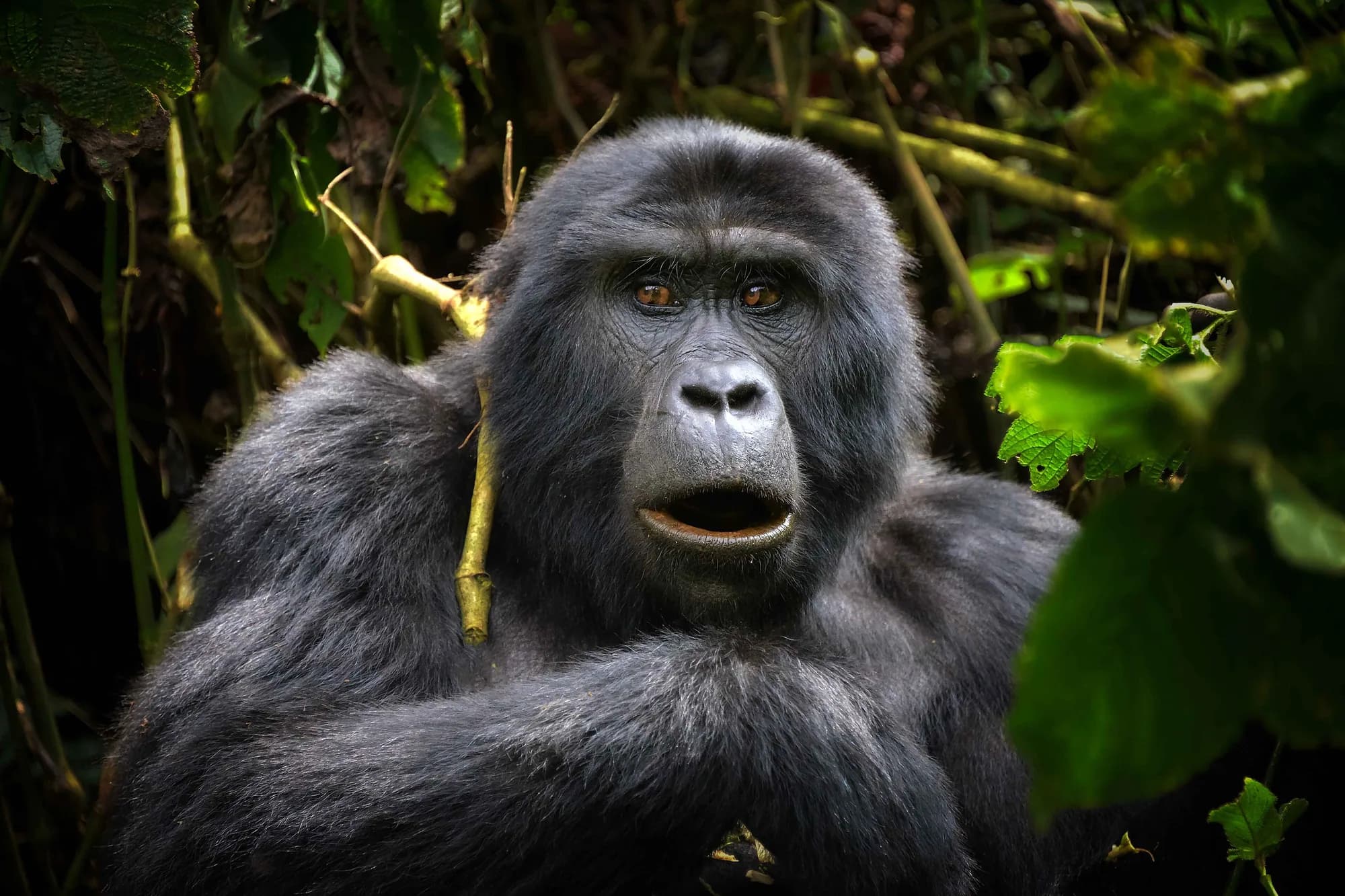
Bwindi, Mgahinga, Volcanoes — and nowhere else on earth
Mountain gorilla — the same forest
Three national parks on this site hold the entire world population, and one hour with a habituated group is the most expensive and most reliably delivered wildlife encounter in Africa. It is also the rare conservation story that has gone the right way.
Virunga bamboo — two parks here, and nowhere else
Golden monkey — the bamboo zone
An orange-gold monkey confined to the bamboo of the Virunga volcanoes, and the best-value permit in the region. It costs a fraction of a gorilla trek, takes half a morning, and most people who go for the gorillas never hear of it.
Nyungwe
Rwenzori Mountains