
Zambia / South Luangwa / Best time to visit — South Luangwa
Best time to visit — South Luangwa
This is a park with two products rather than a high season and a low one. The difference between them is not price or crowding, it is whether the ground you booked can be reached at all.
One wet season, and it takes the park with it
The Luangwa Valley runs a single summer rainfall season. The dry runs roughly May to November and the wet roughly December to March, with the shoulders either side doing most of the damage to itineraries. The research that has been done here works to that calendar and names it: the 2016 leopard study defines a cold dry season of May to August and a hot dry season of September to November, and simply did not sample the wet at all.
The year as this park actually runs
| Months | What it is called here | State of the park |
|---|---|---|
| December to March | Green or emerald season | Rain. Most bush camps closed. Parts of the park unreachable by vehicle. River full |
| April to May | Opening shoulder | Water dropping, grass long, camps reopening on staggered dates, roads drying unevenly |
| May to August | Cold dry | The comfortable months. Cold at dawn, everything open, game spreading out from the river less each week |
| September to November | Hot dry | The concentration months, and brutally hot by October. Best leopard odds. Everything open until the rains arrive |
| Late November | Closing shoulder | The trap month. Early rains have shut a research season here before |
Season names and boundaries are the ones the Luangwa research literature uses; the descriptions of what each does to access are ours, built from what those papers say about what they could and could not do.
Rosenblatt, Creel, Becker, Merkle, Mwape, Schuette and Simpamba — "Effects of a protection gradient on carnivore density and survival: an example with leopards in the Luangwa valley, Zambia", Ecology and Evolution 6(11): 3772-3785 (5 May 2016)
Read 28 September 2026, in full, from the PubMed Central copy. Open access, peer reviewed, and co-authored with an officer of Zambia's own department. Camera traps on two matched grids either side of the Luangwa River across five dry seasons from 2012 to 2014, analysed with closed robust-design capture-recapture. It is the only rigorous leopard density estimate for this park that we could find, and the paper says as much about itself: these are "the first methodologically and statistically rigorous estimates of leopard density and survival" in the population. It is also the source for the park's area as the researchers state it (9,050 km2), the Lupande GMA area (5,660 km2) and the snare-occurrence comparison.
https://pmc.ncbi.nlm.nih.gov/articles/PMC4864144/Why the dry season works, mechanically
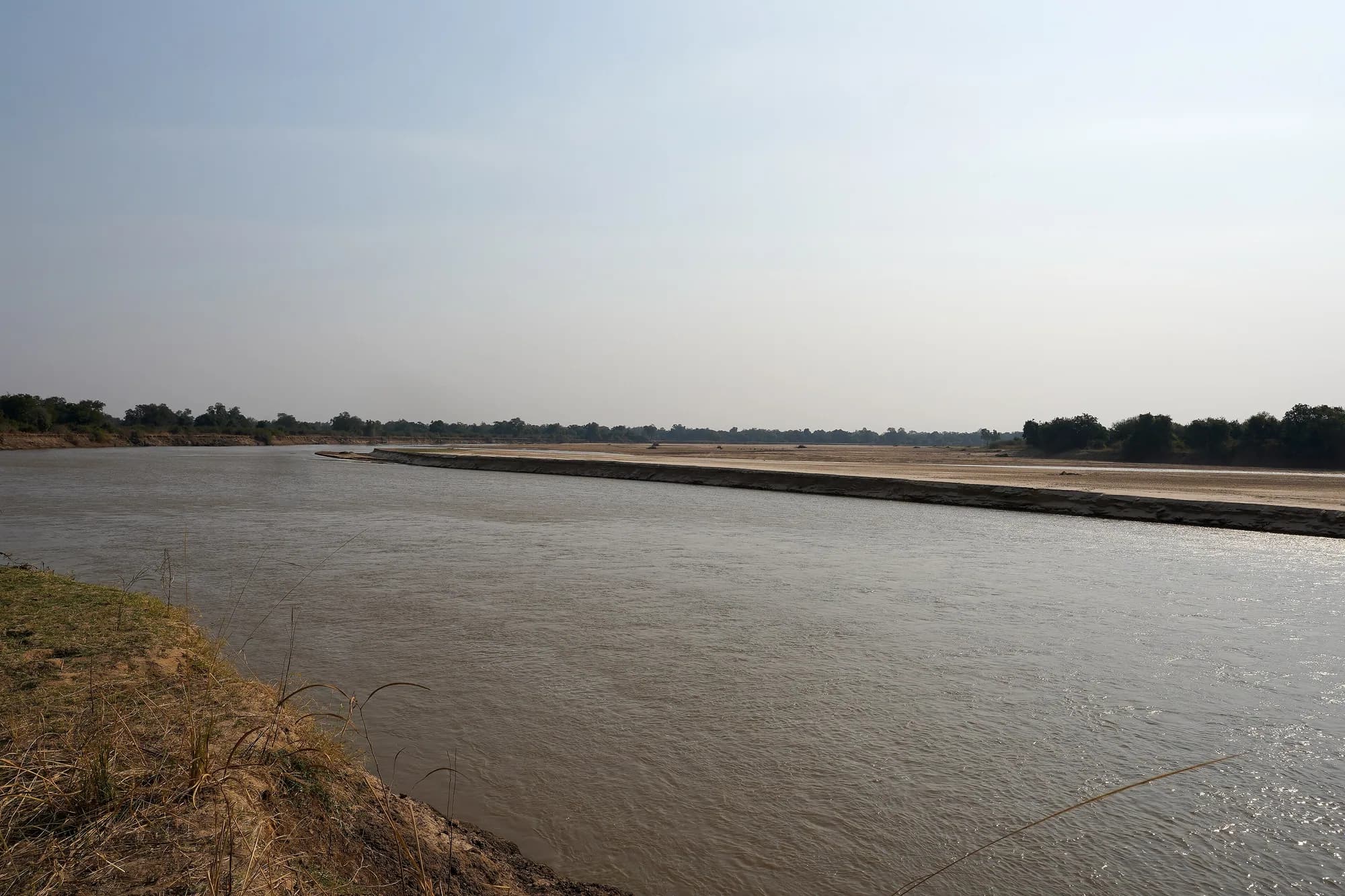
The reason South Luangwa is a dry-season park is not that animals prefer the dry. It is that the Luangwa is, in the researchers' words, the largest perennial water source in the region, and that when everything else in the valley stops running, the river and its ox-bow lagoons are the only water left. Wildlife and human activity alike centre on the river boundaries of the park and the adjoining GMAs, "particularly during the dry season". Every month from June onward tightens that funnel.
The second mechanism is the vegetation. The valley floor is mopane and the higher slopes miombo, with floodplain grassland close to the water; by September the grass is down, the leaves are off much of the mopane, and a leopard lying on a branch at forty metres is a leopard you can see. In February the same animal at the same distance is not there as far as you are concerned.
Large mammals cross the river freely
The 2016 study notes that large mammals move across the Luangwa freely, particularly in the late dry season, which is why it treated the populations on both banks as one. For a visitor that means the late dry is also when the east bank and the west bank stop being separate game-viewing propositions — and when a GMA camp's own frontage improves.
Rosenblatt, Creel, Becker, Merkle, Mwape, Schuette and Simpamba — "Effects of a protection gradient on carnivore density and survival: an example with leopards in the Luangwa valley, Zambia", Ecology and Evolution 6(11): 3772-3785 (5 May 2016)
Read 28 September 2026, in full, from the PubMed Central copy. Open access, peer reviewed, and co-authored with an officer of Zambia's own department. Camera traps on two matched grids either side of the Luangwa River across five dry seasons from 2012 to 2014, analysed with closed robust-design capture-recapture. It is the only rigorous leopard density estimate for this park that we could find, and the paper says as much about itself: these are "the first methodologically and statistically rigorous estimates of leopard density and survival" in the population. It is also the source for the park's area as the researchers state it (9,050 km2), the Lupande GMA area (5,660 km2) and the snare-occurrence comparison.
https://pmc.ncbi.nlm.nih.gov/articles/PMC4864144/The green season — what opens
The emerald season is a genuinely different product rather than a discounted version of the same one, and it is worth taking seriously for the right traveller. zambiatourism.com is explicit that the Luangwa "is best navigated in the rainy season when it is fuller" and that the wet-season boat gives you hippo, crocodile and elephant from the water, with the scenery lush and verdant. The birding case is stronger still: the park is credited with over 400 species, of which the same source counts 39 birds of prey and 47 summer migrants — and the migrants are only there in the summer, which is the wet.
- Boats. The river carries a boat in the rains and effectively does not in October. A boat is not a wet-season consolation, it is a wet-season exclusive.
- Migrants. Forty-seven of the park's birds are summer migrants. A dry-season trip cannot see them at all, at any price, with any guide.
- Newborns. Impala and puku drop in the green months and the predator interest that follows them is the season's set piece.
- Light and sky. Storm light over a green floodplain is the photographic argument, and it is a real one.
- Space. The camps that are open are not full.
And what closes
Most of the bush camps, which are reed and thatch on flood ground. Much of the walking circuit, because you cannot put a walking party across country you cannot reach. Parts of the road network, on evidence rather than assertion — a research team could not get into portions of its own study areas in the wet, and lost a camera section to early rains in a November. Game viewing in the conventional sense, because the water is everywhere and the animals therefore are not concentrated anywhere.
zambiatourism.com — South Luangwa National Park
Read 28 September 2026, along with its activities and accommodation pages. A large and long-standing Zambian travel portal, and the source here for the 9,050 square kilometre area, the 1972 founding, the "60 different animal species and over 400 different bird species" line, the camp list and the statement that on a walk "a qualified walking guide and armed ranger will accompany you". We checked who publishes it and could not establish that: the site carries no ownership or publisher statement, and the only attribution in its footer is to the agency that built it. Treat it as a well-informed trade source rather than an authority, which is how it is labelled everywhere it appears on these pages.
https://www.zambiatourism.com/destinations/national-parks/south-luangwa-national-park/Rosenblatt, Creel, Becker, Merkle, Mwape, Schuette and Simpamba — "Effects of a protection gradient on carnivore density and survival: an example with leopards in the Luangwa valley, Zambia", Ecology and Evolution 6(11): 3772-3785 (5 May 2016)
Read 28 September 2026, in full, from the PubMed Central copy. Open access, peer reviewed, and co-authored with an officer of Zambia's own department. Camera traps on two matched grids either side of the Luangwa River across five dry seasons from 2012 to 2014, analysed with closed robust-design capture-recapture. It is the only rigorous leopard density estimate for this park that we could find, and the paper says as much about itself: these are "the first methodologically and statistically rigorous estimates of leopard density and survival" in the population. It is also the source for the park's area as the researchers state it (9,050 km2), the Lupande GMA area (5,660 km2) and the snare-occurrence comparison.
https://pmc.ncbi.nlm.nih.gov/articles/PMC4864144/Month by month, with the trade named
Every month in the Luangwa buys something and costs something, and the versions of this table you will read elsewhere tend to print only the first half. Below, each month gets both — including the two that the trade is quietest about, April and November, which are the months where a South Luangwa itinerary is most likely to come apart.
Choosing a month
| Month | Conditions | What it is good for | The catch |
|---|---|---|---|
| January to February | Deep wet, hot and humid | Boats, birds, migrants, newborns, storm photography | Most camps shut, walking largely off, much of the park unreachable |
| March | Rain easing, everything green and tall | The last of the boating and the migrants | The least reliable month for actually seeing a large predator |
| April | Drying, grass at its tallest | Empty, green, cheap by this park's standards | Visibility at its worst; camps reopening on dates that differ property by property |
| May | Cold dry begins. Cold at dawn | The first properly reliable driving month, and a beautiful one | Game still dispersed; the funnel has not tightened |
| June to July | Cold dry. Clear, cold mornings | Comfortable walking, everything open, good general game | Nothing much. This is the balanced answer |
| August | Warming, water dropping fast | The point where concentration and comfort overlap | Peak demand on small camps begins |
| September to October | Hot dry, hot to very hot by October | The best game concentration and the best leopard odds of the year | Heat, and the most vehicles the park ever carries |
| November | The break. Hot, then the first storms | Dramatic, and empty of people | The month itineraries collapse in. A research season has been cut short here by early rains |
| December | Rain establishing | Green-season pricing with some dry-season access left | A coin toss, and not one we would take on a first trip |
Conditions described here are the seasonal pattern the research literature uses and the visibility logic that follows from mopane and floodplain vegetation. We publish no monthly rainfall or temperature figures for Mfuwe, because we found none from a Zambian meteorological authority that we could read.
The night drive has its own calendar
Night driving is the activity that most distinguishes a Zambian safari from a Kenyan or Tanzanian one, and it is not equally good all year. It is a dry-season product for a mundane reason: the tracks that carry a vehicle after dark are the tracks that carry a vehicle at all, and in the wet there are fewer of them.
Night drives through the year
| Season | Availability | What it delivers |
|---|---|---|
| Cold dry, May to August | Standard at lodges with vehicle access | Genet, civet, porcupine, bushbaby, owls; leopard on the move early |
| Hot dry, September to November | Standard, and the best of the year | Leopard activity concentrated near water; lion moving earlier as the heat holds |
| Green season | Where the road network allows, from the all-weather sector | Fewer tracks, wetter going, more insects, and the game less predictable |
Availability here describes what the road network and the camps permit, not a departmental rule. The Zambia Wildlife Act does not restrict viewing after dark, and the legal position is set out in full on the sightings page.
The one seasonal detail worth planning around
An afternoon drive that continues after dark and a separate night drive are different products with different lengths, and camps use the same words for both. In the hot dry months, when the vehicle leaves at 16:00 and comes back at 20:00, you get roughly two hours of dark. In midwinter, with sunset early and dinner at a fixed hour, you may get considerably less. Ask what time the vehicle is due back.
zambiatourism.com — South Luangwa National Park
Read 28 September 2026, along with its activities and accommodation pages. A large and long-standing Zambian travel portal, and the source here for the 9,050 square kilometre area, the 1972 founding, the "60 different animal species and over 400 different bird species" line, the camp list and the statement that on a walk "a qualified walking guide and armed ranger will accompany you". We checked who publishes it and could not establish that: the site carries no ownership or publisher statement, and the only attribution in its footer is to the agency that built it. Treat it as a well-informed trade source rather than an authority, which is how it is labelled everywhere it appears on these pages.
https://www.zambiatourism.com/destinations/national-parks/south-luangwa-national-park/If you go once
September, and book it in the spring before. It is the month that gives you the tightest concentration of game on the river, the whole walking circuit open, every bush camp standing, night drives at their best, and the highest chance of the leopard you came for — at the cost of heat and of company at sightings. If September is impossible, take late August before October: October adds heat and takes nothing away except a little of the crowd.
If your dates are fixed
| You can only travel in | Go to South Luangwa? | Or instead |
|---|---|---|
| July or August | Yes, without reservation | Nothing to change. This is a good Luangwa trip |
| October | Yes, if you can handle the heat and the vehicles | Nothing, but book the smaller camps and travel early in the month |
| December to February | Only for birds, boats and green | Lower Zambezi, where the canoeing works, or hold the trip |
| March or April | Marginal. The month depends on the year's rain | Ask your camp whether its own reopening date is confirmed or provisional before you commit |
| November | The riskiest month in the calendar | Move a fortnight earlier if you possibly can. Late October is a different trip from late November |
This is advice, not a schedule. No Zambian authority publishes park opening and closing dates for South Luangwa that we could find, so no row here rests on one.