
Zambia / South Luangwa / Sightings log — South Luangwa
Sightings log — South Luangwa
This site runs no moderated sightings log. What it can give you about South Luangwa is the two rules that make its sightings possible — who may take you out on foot, and who may point a light at an animal after dark — traced to the statute rather than to a brochure.
The walking safari was invented here, and the state says so
The Zambia Tourism Agency's own national parks page puts it in one line: "The Safari destinations in Zambia are very popular for walking safaris which were pioneered by Norman Carr." Carr — 19 July 1912 to 1 April 1997 — petitioned Senior Chief Nsefu in 1950 to set aside part of Kunda tribal land as a game reserve and built there the first game-viewing camp open to the public in Northern Rhodesia, with the proceeds going back to the community. His ashes were scattered in the Luangwa. Whatever a camp's marketing says, the claim that this is where the walking safari began is one the Zambian state itself makes.
And the statute names it
The Zambia Wildlife Act 2015 defines "non-consumptive tourism" as conventional tourist activities "such as viewing animals, photographing, bird watching, wilderness walks, walking safaris, angling, canoeing and boat rides". Walking safaris appear by name in Zambian primary legislation. Very few tourist activities anywhere do.
Zambia Tourism Agency — National Parks (zambia.travel)
Read 28 September 2026. The official tourism agency site linked from the Ministry of Tourism's own navigation, and the only government source we reached that says anything at all about the activity this park is famous for: "The Safari destinations in Zambia are very popular for walking safaris which were pioneered by Norman Carr." It publishes no entry fee, no tariff, no park opening dates, no sector map and nothing about armed escorts. Requests to the site root were refused with HTTP 403; the parks page itself served.
http://zambia.travel/nationalparks.htmlRepublic of Zambia — The Zambia Wildlife Act, No. 14 of 2015
Read 28 September 2026, in full. One hundred and two pages, 149 sections in 15 Parts, fetched as the FAO/ECOLEX copy of the English text because the Zambian Legal Information Institute served HTTP 403 behind a bot check to every request we made on the day, as did the National Assembly site, which timed out. This is the statute that governs everything a visitor does inside South Luangwa: who may guide, who may carry a rifle, what may be done after dark, and — at section 27 — who has the power to set the entry fee. It is the source for every legal statement on these pages. It does not itself contain a single figure in kwacha or dollars for entering a National Park.
https://faolex.fao.org/docs/pdf/zam163735.pdfWikipedia — South Luangwa National Park (article and wikitext)
Read 28 September 2026, including the raw wikitext. Relevant because it is where most repetitions of the leopard-density claim ultimately lead. Its Nsefu Sector section states that the area "supports some of the highest recorded densities of leopards in southern Africa" and hangs that on two references. We could not verify either: the first, given as Thirgood et al., "The Dynamics of Wildlife in South Luangwa National Park", African Journal of Ecology 45.4 (2007): 676-685, returns nothing in Crossref, and Crossref's own index of that journal issue contains no article by those authors at those pages. The second is a 2012 Zambian Carnivore Programme report for which we found no public copy. The article's founding dates — a 1904 game reserve and a 1938 one — both carry citation-needed tags.
https://en.wikipedia.org/wiki/South_Luangwa_National_ParkWho may walk you, and what we could establish about the armed scout
This is the rule that distinguishes South Luangwa from Mana Pools across the Zambezi, and we went to the statute to pin it down. The guide half is unambiguous. Section 45(2)(b) of the Zambia Wildlife Act authorises a holder of a professional guide's permit to "take out clients for game drives and walks as may be specified in the permit", and section 45(3)(a) makes it an offence to conduct a photographic or viewing safari for reward in a National Park without one. Section 45(4) makes it a separate offence to employ somebody to do a guide's job without a permit. So: a licensed, permitted individual, whose permit specifies walks, is a legal requirement for a commercial walking safari in South Luangwa, and both the guide and the camp are on the hook.
The armed half is where we have to be careful, because the Act does not say what everybody says it says. Nowhere in the Zambia Wildlife Act 2015 did we find a provision requiring a walking party to be escorted by an armed scout. What the Act does contain is section 20, which makes it an offence to convey a firearm or other weapon into a National Park, or to carry or use one inside it, without a permit issued by the Director — and section 20(4), which disapplies the whole section for "a wildlife officer, honorary wildlife police officer, community scout or other police officer in the performance of duties". That is the legal machinery that lets a rifle exist on a Luangwa walk at all. It explains who the armed man is: an officer or a scout, exempt from the weapons ban because he is on duty, rather than a lodge employee carrying a gun.
The walking party, and where each requirement comes from
| Who | Requirement | Source | How firm |
|---|---|---|---|
| The guide | Must hold a professional guide's permit whose terms cover walks | Zambia Wildlife Act 2015, s45(2)(b), s45(3)(a), s45(4) | Statutory. Not in doubt |
| The rifle | May only be carried in a National Park under a Director's permit, or by an officer, honorary officer, community scout or police officer on duty | Zambia Wildlife Act 2015, s20(1), s20(3), s20(4) | Statutory. Not in doubt |
| An armed escort on every commercial walk | Described as universal practice. zambiatourism.com states that on a nature walk "A qualified walking guide and armed ranger will accompany you" | A trade portal whose publisher we could not identify | Practice, and we could not find it in the Act or in any instrument we could reach |
| The number in the party | Commonly limited by camps | None we could reach | Operator policy. No statutory limit found |
The honest statement is this. The armed scout on a South Luangwa walk is real, it is universal in practice, and it is described in the same terms by every account we read. We could not trace it to a Zambian statutory requirement. It may well be imposed by regulations made under section 27(m) of the Act — "the rules of conduct and behaviour of persons while within a National Park" — or by the prescribed qualifying conditions attached to a professional guide's permit under section 45(1). We could not read either, because Zambian subsidiary legislation is not reachable in any index we could get into.
Republic of Zambia — The Zambia Wildlife Act, No. 14 of 2015
Read 28 September 2026, in full. One hundred and two pages, 149 sections in 15 Parts, fetched as the FAO/ECOLEX copy of the English text because the Zambian Legal Information Institute served HTTP 403 behind a bot check to every request we made on the day, as did the National Assembly site, which timed out. This is the statute that governs everything a visitor does inside South Luangwa: who may guide, who may carry a rifle, what may be done after dark, and — at section 27 — who has the power to set the entry fee. It is the source for every legal statement on these pages. It does not itself contain a single figure in kwacha or dollars for entering a National Park.
https://faolex.fao.org/docs/pdf/zam163735.pdfzambiatourism.com — South Luangwa National Park
Read 28 September 2026, along with its activities and accommodation pages. A large and long-standing Zambian travel portal, and the source here for the 9,050 square kilometre area, the 1972 founding, the "60 different animal species and over 400 different bird species" line, the camp list and the statement that on a walk "a qualified walking guide and armed ranger will accompany you". We checked who publishes it and could not establish that: the site carries no ownership or publisher statement, and the only attribution in its footer is to the agency that built it. Treat it as a well-informed trade source rather than an authority, which is how it is labelled everywhere it appears on these pages.
https://www.zambiatourism.com/destinations/national-parks/south-luangwa-national-park/Night drives are legal here, and this is exactly why
Zambia permits night driving where Kenya and Tanzania largely do not, and the reason is visible in the drafting. Section 73 of the Zambia Wildlife Act is headed "Prohibition of hunting during hours of darkness" and it makes it an offence, except with the written permission of the Committee, during the hours of darkness to hunt a wild animal, or "for the purpose of or in connection with hunting, or assisting in hunting a wild animal, [to use] any torch, flare, headlamp or any other artificial light". Subsection (2) defines hours of darkness as the period from half an hour after sunset to half an hour before sunrise.
Everything in that section is tied to hunting, and the Act defines "hunt" narrowly: it "includes to kill or the doing of an act immediately directed at killing". Pointing a spotlight at a genet is not an act immediately directed at killing it. So the statutory night-time restriction does not reach a viewing spotlight, and there is nothing else in the Act that does. Zambia's permissiveness about night drives is not an oversight or an informal tolerance; it is what the statute says when you read it carefully.
What section 73 catches, and what it does not
| Activity after dark | Caught by s73? |
|---|---|
| Hunting a wild animal | Yes — an offence without the Committee's written permission |
| Using a torch, flare or headlamp in connection with hunting | Yes |
| Using a spotlight to view or photograph an animal | No. The section is tied to hunting, and hunting is defined as killing or an act immediately directed at it |
| Driving in a National Park after dark | Not addressed |
| Using a vehicle to drive or stampede a game animal | Caught by section 74 instead, at any hour, without the Committee's written permission |
Section 74 is worth reading twice. It is headed "Game drives", and in this statute that phrase means driving animals in the beating sense, not taking tourists out in a Land Cruiser. A reader who searches the Act for "game drive" and finds an offence has found the wrong thing.
The practical rule is your camp's, not the state's
Because the statute is silent on viewing after dark, when a night drive starts and ends, how a spotlight may be used, how close a vehicle may go and whether a light may be held on a hunting cat are all matters of operator policy and guide discipline. Ask what your camp's rules are. A guide who takes a red filter off the lamp for a hunting leopard is doing something no Zambian law prohibits and every decent guiding standard does.
Republic of Zambia — The Zambia Wildlife Act, No. 14 of 2015
Read 28 September 2026, in full. One hundred and two pages, 149 sections in 15 Parts, fetched as the FAO/ECOLEX copy of the English text because the Zambian Legal Information Institute served HTTP 403 behind a bot check to every request we made on the day, as did the National Assembly site, which timed out. This is the statute that governs everything a visitor does inside South Luangwa: who may guide, who may carry a rifle, what may be done after dark, and — at section 27 — who has the power to set the entry fee. It is the source for every legal statement on these pages. It does not itself contain a single figure in kwacha or dollars for entering a National Park.
https://faolex.fao.org/docs/pdf/zam163735.pdfWhat a night drive actually delivers here
Night driving is the reason South Luangwa's species list on the ground is longer than its neighbours'. A catalogue of nocturnal animals that a day-only park simply cannot show you becomes routine, and the leopard — which is not strictly nocturnal but is far more active and far more visible after dark — stops being a matter of luck and becomes a matter of hours.
Day-only against day-and-night, same park
| A park without night drives | South Luangwa | |
|---|---|---|
| Leopard | A daytime sighting, usually asleep in a tree | An animal hunting, on a measured density of 8.50 per 100 km2 inside the park, over multiple evenings |
| Genet, civet, honey badger | Effectively absent from the trip | Routine |
| Porcupine, bushbaby, spring hare | Effectively absent | Routine |
| Owls and nightjars | Heard | Seen |
| Lion | Resting through the heat | Moving, and audible |
| Hippo | In the water | Out of it, grazing, which is where they are dangerous |
The leopard density figure is the measured one from the 2016 study; the rest is what the activity gives you rather than a count of anything.
One sighting you may not want
The honest downside of night driving is what it does to the animals. A spotlight party on a hunting cat can end the hunt, and a park that runs night drives every evening on the same stretch of river is running an experiment on its own leopards. We found no published Zambian study of that effect in the Luangwa. It is a reason to care about which camp you choose, and to notice how your guide behaves when a leopard is stalking.
Rosenblatt, Creel, Becker, Merkle, Mwape, Schuette and Simpamba — "Effects of a protection gradient on carnivore density and survival: an example with leopards in the Luangwa valley, Zambia", Ecology and Evolution 6(11): 3772-3785 (5 May 2016)
Read 28 September 2026, in full, from the PubMed Central copy. Open access, peer reviewed, and co-authored with an officer of Zambia's own department. Camera traps on two matched grids either side of the Luangwa River across five dry seasons from 2012 to 2014, analysed with closed robust-design capture-recapture. It is the only rigorous leopard density estimate for this park that we could find, and the paper says as much about itself: these are "the first methodologically and statistically rigorous estimates of leopard density and survival" in the population. It is also the source for the park's area as the researchers state it (9,050 km2), the Lupande GMA area (5,660 km2) and the snare-occurrence comparison.
https://pmc.ncbi.nlm.nih.gov/articles/PMC4864144/The river and the lagoons, which are the sighting mechanism
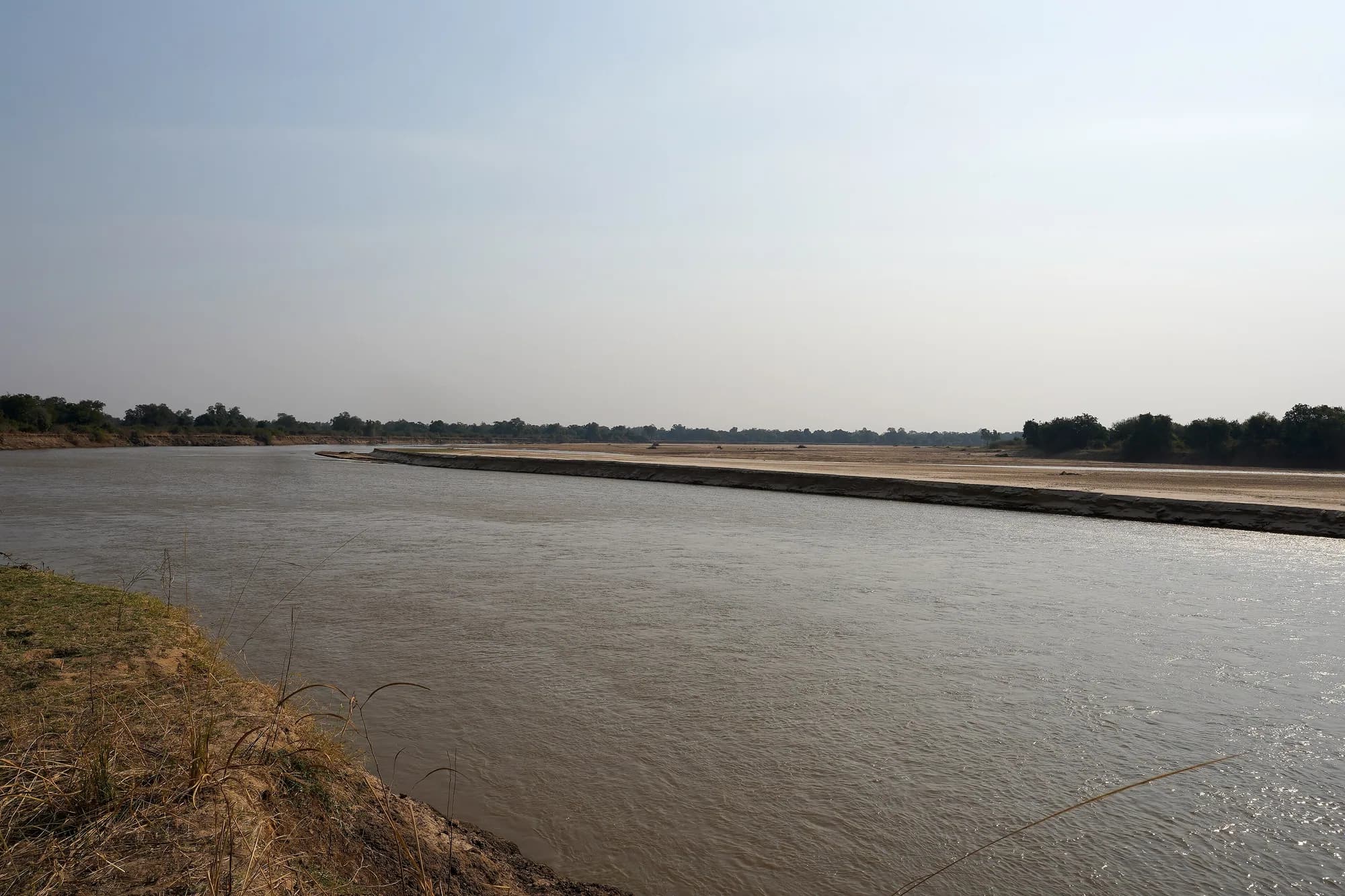
Sightings in South Luangwa are not distributed across the park. They are distributed along a strip of river and around a set of ox-bow lagoons, and the reason is water. The Luangwa is the largest perennial water source in the region; when the seasonal tributaries stop, the river and the cut-off bends are the only water in the valley floor, and by September everything that drinks is within walking distance of one or the other.
- Lagoons are the productive ground. An ox-bow that still holds water in October is a waterhole with a predator on it, and the guides know which ones have gone dry this year and which have not.
- Riverine forest and ebony groves along the bank are the leopard habitat. The Nsefu sector's mosaic of mature riverine forest, ebony groves, mopane woodland and floodplain is described in exactly those terms.
- The floodplain is where the plains game is, and the four species that have been counted here — impala, puku, zebra, warthog — are the leopard's food and therefore the thing to watch for.
- Both banks are one population. Large mammals cross the Luangwa freely, particularly in the late dry season, so a camp on the east bank is not looking at different animals.
- Sandbanks and the channel itself are the hippo and crocodile show, and the wet-season boat is the only way to see it from the water.
Why repeated ground beats new ground here
The strip is small — the two research grids that cover the working part of this park total 313 square kilometres out of 9,050. A guide who has watched the same six lagoons for a week knows which leopard is using which, and that knowledge is worth more than a longer drive. This is an argument for staying put, and it is the single most useful thing on this page.
Rosenblatt, Creel, Becker, Merkle, Mwape, Schuette and Simpamba — "Effects of a protection gradient on carnivore density and survival: an example with leopards in the Luangwa valley, Zambia", Ecology and Evolution 6(11): 3772-3785 (5 May 2016)
Read 28 September 2026, in full, from the PubMed Central copy. Open access, peer reviewed, and co-authored with an officer of Zambia's own department. Camera traps on two matched grids either side of the Luangwa River across five dry seasons from 2012 to 2014, analysed with closed robust-design capture-recapture. It is the only rigorous leopard density estimate for this park that we could find, and the paper says as much about itself: these are "the first methodologically and statistically rigorous estimates of leopard density and survival" in the population. It is also the source for the park's area as the researchers state it (9,050 km2), the Lupande GMA area (5,660 km2) and the snare-occurrence comparison.
https://pmc.ncbi.nlm.nih.gov/articles/PMC4864144/Wikipedia — South Luangwa National Park (article and wikitext)
Read 28 September 2026, including the raw wikitext. Relevant because it is where most repetitions of the leopard-density claim ultimately lead. Its Nsefu Sector section states that the area "supports some of the highest recorded densities of leopards in southern Africa" and hangs that on two references. We could not verify either: the first, given as Thirgood et al., "The Dynamics of Wildlife in South Luangwa National Park", African Journal of Ecology 45.4 (2007): 676-685, returns nothing in Crossref, and Crossref's own index of that journal issue contains no article by those authors at those pages. The second is a 2012 Zambian Carnivore Programme report for which we found no public copy. The article's founding dates — a 1904 game reserve and a 1938 one — both carry citation-needed tags.
https://en.wikipedia.org/wiki/South_Luangwa_National_ParkAgainst the alternatives, framed as a trade
Four places a South Luangwa traveller is also considering
| Park | What it does better | What South Luangwa does better |
|---|---|---|
| Mana Pools, Zimbabwe | You may walk unescorted, with no guide, no scout and no qualification, on ZimParks' own rule. Nothing else in Africa offers that | Guided walking in the tradition that invented it, night drives, and a measured leopard density |
| North Luangwa, Zambia | Remoter, walking-only, no public roads, almost no one there, and Zambia's only black rhino | Access, camps, night drives, and a trip you can actually build around a flight |
| Lower Zambezi, Zambia | Canoeing on a great river, and a genuinely different way of moving through a park | Walking, leopard, and the ox-bow concentration that canoeing cannot reach |
| Kruger, South Africa | Self-drive, infrastructure, tarred roads, rest camps, and the highest recorded leopard densities on the continent at up to 13.2 per 100 km2 in the best-protected private ground | Walking as the main activity rather than a bookable extra, and night driving as standard rather than as a ranger-led supplement |
The Kruger figure is from a 2025 spatial capture-recapture study across central and southern Kruger, Sabi Sand and Karingani, and its range starts at 2.6. It is the top of that range that exceeds South Luangwa's 8.50, not the whole of it.
The pairing we would actually recommend, and why the order matters
South Luangwa and Mana Pools, in that order, because they are the two poles of the same idea. ZimParks' own management plan for Mana Pools states that visitors need show no qualification, prove no capability, and take neither a scout nor a professional guide in order to walk. South Luangwa is the exact opposite: permitted guide, armed escort, no exceptions. Learn to walk in dangerous-game country behind a scout on the Luangwa, then cross to the Zambezi and do it with nobody in front of you. Doing it the other way round is how people get hurt, and a traveller who books one expecting the other will be disappointed in whichever direction.
"Counting spots: Leopard density along a gradient of conservation rigor", Conservation Science and Practice (2025)
Abstract read 28 September 2026 via the OpenAlex record; the publisher's full text was refused with HTTP 403. Ten camera-trap surveys across central and southern Kruger National Park, Sabi Sand Game Reserve and Karingani Game Reserve, analysed with multi-session spatial capture-recapture. Reported densities range from 2.6 +/- 0.6 to 13.2 +/- 2.6 leopards per 100 km2. We use it here only as the comparison that a claim about Africa's highest leopard density has to survive, and we flag that its method is not the method used in the Luangwa.
https://conbio.onlinelibrary.wiley.com/doi/10.1111/csp2.70197Rosenblatt, Creel, Becker, Merkle, Mwape, Schuette and Simpamba — "Effects of a protection gradient on carnivore density and survival: an example with leopards in the Luangwa valley, Zambia", Ecology and Evolution 6(11): 3772-3785 (5 May 2016)
Read 28 September 2026, in full, from the PubMed Central copy. Open access, peer reviewed, and co-authored with an officer of Zambia's own department. Camera traps on two matched grids either side of the Luangwa River across five dry seasons from 2012 to 2014, analysed with closed robust-design capture-recapture. It is the only rigorous leopard density estimate for this park that we could find, and the paper says as much about itself: these are "the first methodologically and statistically rigorous estimates of leopard density and survival" in the population. It is also the source for the park's area as the researchers state it (9,050 km2), the Lupande GMA area (5,660 km2) and the snare-occurrence comparison.
https://pmc.ncbi.nlm.nih.gov/articles/PMC4864144/What this page is not
We do not run a sightings log for South Luangwa, and we are not going to publish one. There is no moderated public log for this park that we could find, the camps' own social feeds are marketing, and a sightings board assembled from those would be a list of the best days somebody had, which is the opposite of useful for planning.
- No sighting frequencies, no percentage chances and no "leopard on 9 out of 10 trips" figures. Nobody publishes the denominator.
- No hippo-per-kilometre figure for the Luangwa. We could not trace the widely repeated one to any survey.
- No lion, elephant or wild dog counts for this park. We found no survey we could read, and DNPW's 2025 brochure — which might contain one — returns 403 along with everything else in that directory.
- No named individual animals. Habituated leopards get names in this valley; they also get moved, and they die.
- No claim that South Luangwa has the highest leopard density in Africa, including on our own park record, which currently makes it and should not.
What we will say
On a five-night dry-season trip in the Mfuwe sector with three or four night drives, South Luangwa is among the most reliable leopard destinations on the continent, and that reliability rests on a published density of 8.50 animals per 100 square kilometres, a river that concentrates them, and a national law that lets you look after dark. That is a better sentence than the superlative, and every part of it is sourced.
Rosenblatt, Creel, Becker, Merkle, Mwape, Schuette and Simpamba — "Effects of a protection gradient on carnivore density and survival: an example with leopards in the Luangwa valley, Zambia", Ecology and Evolution 6(11): 3772-3785 (5 May 2016)
Read 28 September 2026, in full, from the PubMed Central copy. Open access, peer reviewed, and co-authored with an officer of Zambia's own department. Camera traps on two matched grids either side of the Luangwa River across five dry seasons from 2012 to 2014, analysed with closed robust-design capture-recapture. It is the only rigorous leopard density estimate for this park that we could find, and the paper says as much about itself: these are "the first methodologically and statistically rigorous estimates of leopard density and survival" in the population. It is also the source for the park's area as the researchers state it (9,050 km2), the Lupande GMA area (5,660 km2) and the snare-occurrence comparison.
https://pmc.ncbi.nlm.nih.gov/articles/PMC4864144/Department of National Parks and Wildlife — "Park Entry Fees 2025" (attachment 4575, published 27 June 2025)
Attempted 28 September 2026 and refused. The document exists: DNPW's own media library, queried through the WordPress REST route on the departmental sub-site, returns it as attachment id 4575, mime type application/pdf, title "Park Entry Fees 2025", dated 27 June 2025. The file itself returns HTTP 403 Forbidden — to a plain request, to a browser user agent, with a referer from the department's own home page, over HTTP and over HTTPS alike. So does the "Department of National Parks & Wildlife — Brochure 2025" uploaded the same day, and so does every other file under that directory including the department's own 32-pixel logo. There is no copy in the Internet Archive. We could not read this document and we will not print a figure in its place.
https://www.mot.gov.zm/dnpw/wp-content/uploads/2025/06/Park-Entry-Fees-2025.pdf