
Zambia / South Luangwa / Where to stay — South Luangwa
Where to stay — South Luangwa
Thirty-odd properties, two banks, and one distinction that nobody puts on a website: whether the bed is inside a national park or inside a buffer zone with people living in it. It changes the ground around you, not the view.
The line your camp is on
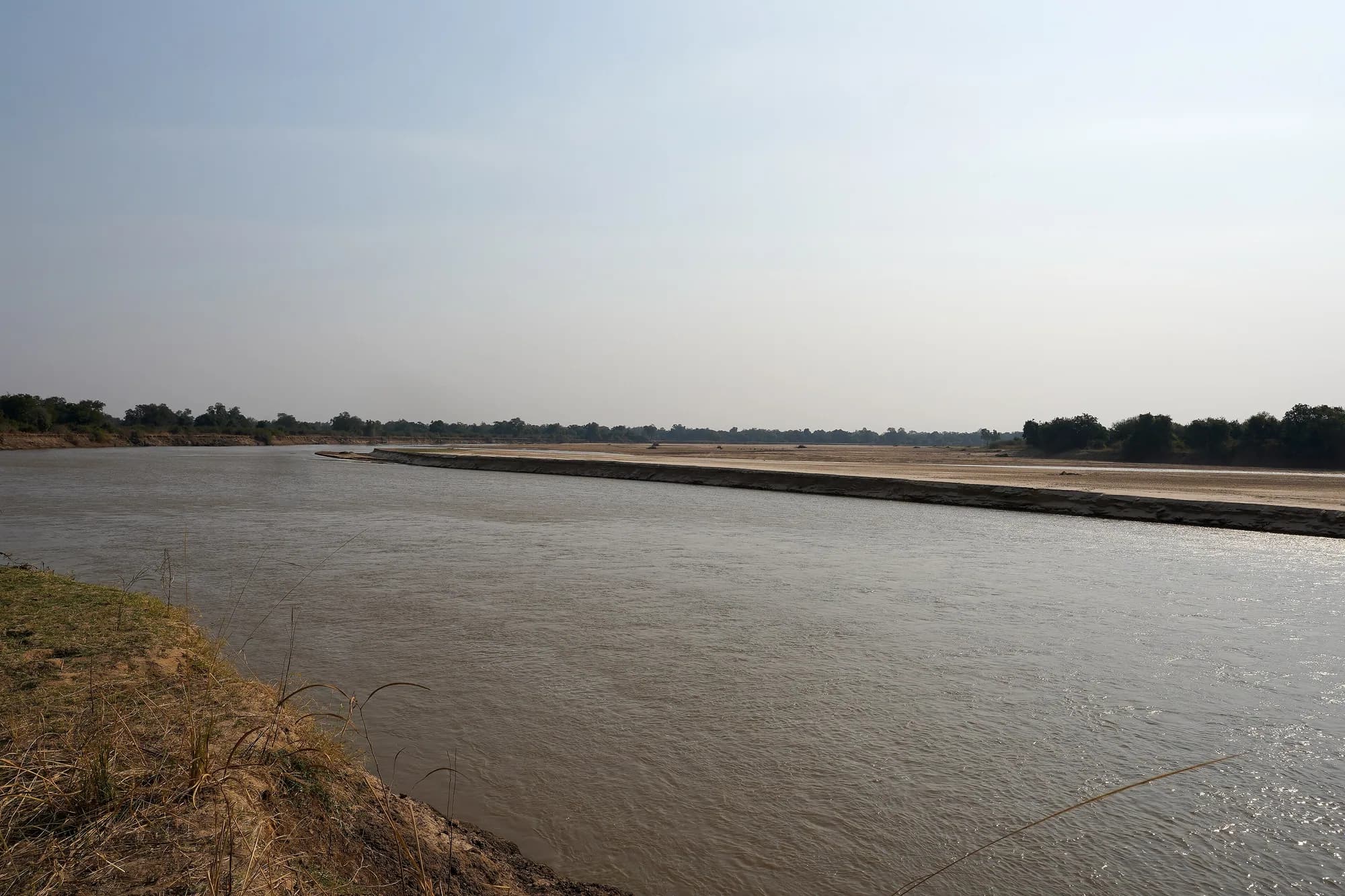
The Luangwa River is the boundary. West of it, in the stretch that matters, is South Luangwa National Park — 9,050 square kilometres, IUCN Category II, strictly protected, with photographic tourism and law-enforcement patrols. East of it is Lupande Game Management Area — 5,660 square kilometres, IUCN Category VI, intended as a buffer allowing a variety of natural-resource uses, with human settlement permitted and increasing. A great many of the camps that advertise themselves as South Luangwa camps stand in the second one.
This is not a criticism and it is not a warning. Several of the valley's best-regarded properties are on the east bank, they overlook the same water, and their guests spend their mornings and evenings inside the National Park. It matters for three concrete reasons: the ground immediately around the camp carries less game than the ground you drive into, the camp's community and conservation levies exist because of where it sits, and a river crossing is part of your day.
The same river, and what the management line does to the land behind the camp
| West bank, National Park | East bank, Lupande GMA | |
|---|---|---|
| Protection | IUCN Category II, strict | IUCN Category VI, multiple use |
| Settlement | None permitted | Permitted and increasing |
| Leopard density, 2012-2014 | 8.50 per 100 km2 | 5.08 per 100 km2 on the eastern grid |
| Wire-snare occurrence, median probability | 0.14 | 0.74 |
| Historic trophy hunting | Not permitted in a National Park | Yes, outside the 2013-2015 moratorium |
| Getting to your morning drive | You are already there | A crossing, and then the gate |
Densities and snare figures from the 2016 leopard study. The eastern figure covers part of the Nsefu sector as well as Lupande, so it understates the contrast with pure GMA land rather than overstating it.
Rosenblatt, Creel, Becker, Merkle, Mwape, Schuette and Simpamba — "Effects of a protection gradient on carnivore density and survival: an example with leopards in the Luangwa valley, Zambia", Ecology and Evolution 6(11): 3772-3785 (5 May 2016)
Read 28 September 2026, in full, from the PubMed Central copy. Open access, peer reviewed, and co-authored with an officer of Zambia's own department. Camera traps on two matched grids either side of the Luangwa River across five dry seasons from 2012 to 2014, analysed with closed robust-design capture-recapture. It is the only rigorous leopard density estimate for this park that we could find, and the paper says as much about itself: these are "the first methodologically and statistically rigorous estimates of leopard density and survival" in the population. It is also the source for the park's area as the researchers state it (9,050 km2), the Lupande GMA area (5,660 km2) and the snare-occurrence comparison.
https://pmc.ncbi.nlm.nih.gov/articles/PMC4864144/What is actually there, named
zambiatourism.com's accommodation index for South Luangwa lists around thirty-seven properties. We reproduce the names below because a reader planning this park needs to know that it is not a two-lodge destination, and because the groupings tell you how the valley's tourism is structured — a handful of multi-camp operators running walking circuits, and a long tail of owner-operated single camps.
- Multi-camp operators running circuits: The Bushcamp Company (Mfuwe Lodge plus Bilimungwe, Chamilandu, Kuyenda, Kapamba, Chindeni and Zungulila bush camps); Time + Tide (Chinzombo, Mchenja, Nsolo, Luwi, Kakuli); Remote Africa Safaris (Tafika Camp and Tafika Walking Trails).
- Other named camps and lodges on the index: Kafunta River Lodge, Three Rivers Camp, Island Bush Camp, Puku Ridge, Msandile River Lodge, Kulandila Camp, Flatdogs Camp, Track and Trail River Camp, Sungani Lodge, Thornicroft Lodge, Lion Camp Safari Lodge, Chichele Presidential, Chikunto Safaris, Kaingo Camp, Mwamba Camp.
- Listed more briefly: Croc Valley Camp, Kudu Safari Lodge, Malama Umoyo Cottages, Munyamadzi Game Reserve, Njobvu Safari, Nkonzi Camp, Robin's House, Wildlife Camp.
What this list is and is not
It is a directory listing on a commercial portal whose publisher we could not identify, reproduced so that a reader knows what exists. It is not a recommendation, it is not complete, and its ordering is the site's own. We publish no rate for any property named here, because we have no rate for any property named here that came from anywhere but a seller.
zambiatourism.com — South Luangwa National Park
Read 28 September 2026, along with its activities and accommodation pages. A large and long-standing Zambian travel portal, and the source here for the 9,050 square kilometre area, the 1972 founding, the "60 different animal species and over 400 different bird species" line, the camp list and the statement that on a walk "a qualified walking guide and armed ranger will accompany you". We checked who publishes it and could not establish that: the site carries no ownership or publisher statement, and the only attribution in its footer is to the agency that built it. Treat it as a well-informed trade source rather than an authority, which is how it is labelled everywhere it appears on these pages.
https://www.zambiatourism.com/destinations/national-parks/south-luangwa-national-park/Lodge, bush camp, and the word that hides the difference
Zambia uses "bush camp" for something specific and the word travels badly. A Luangwa bush camp is typically four to six rooms of reed, thatch and canvas, built each season and taken down or left to the rains at the end of it, sited on a seasonal tributary well away from the road network, and run as one leg of a walking circuit. A lodge is a permanent structure with year-round access, usually near Mfuwe, usually with its own vehicles and a night-drive operation.
Three kinds of bed in this valley
| Main-sector lodge | Bush camp | GMA lodge or camp | |
|---|---|---|---|
| Where | Mfuwe sector, west bank, all-weather road | Remote north or south of the park | East bank, Lupande |
| Season | The longest in the valley | Dry only; built and struck each year | Long, subject to the crossing |
| Size | Larger — a real lodge | Four to six rooms is normal | Varies widely |
| Main activity | Drives, including night drives | Walking, with vehicle support | Drives into the park |
| Night drives | Yes | Depends on the camp | Yes, from the park side |
| Suits | A first trip, a short trip, children | A second trip, a walking trip | Value, river frontage, longer stays |
Composed from the structure of the published camp list and the activity descriptions on the same source. No property is named in this table on purpose; the categories are what you are choosing between, and camps move between them.
The question that separates a real bush camp from a marketing one
Ask whether the camp is dismantled or abandoned at the end of the season and rebuilt. A camp that is genuinely taken down each year is genuinely in flood country, genuinely remote, and genuinely walking-led. A camp described as a bush camp that stands all year is a small lodge, which may be exactly what you want but is a different trip.
Children, and why this park is harder than it looks
South Luangwa is often sold as family-friendly on the strength of the Mfuwe sector's easy access, and for driving it broadly is. The complication is the activity the park is actually for. Walking safaris in dangerous-game country have minimum ages that vary camp by camp and are set by the operator, not by the state — the Zambia Wildlife Act sets no age limit for anything a visitor does — so the age rule you are given is a commercial policy that a different camp may set differently.
- Ask the camp's minimum age for a walking safari and for a night drive, separately. They are usually different numbers.
- Ask whether the camp takes children at all in the peak weeks, and whether it operates a family unit or exclusive-use option.
- Ask whether a child who cannot walk can be supervised in camp, and by whom, while the adults do.
- Ask whether the camp is fenced. Most Luangwa camps are not, and elephant and hippo through camp at night is normal here rather than exceptional.
- Ask what the child rate is and what it does to park fees, given that we cannot tell you whether a child band exists in the tariff at all.
Where we have no answer
We could not establish whether Zambia's unreadable park entry tariff has a child rate, a child age boundary, or an infant exemption. Every other national tariff we have read on this site does. Assume nothing and get the camp's figure in writing.
Republic of Zambia — The Zambia Wildlife Act, No. 14 of 2015
Read 28 September 2026, in full. One hundred and two pages, 149 sections in 15 Parts, fetched as the FAO/ECOLEX copy of the English text because the Zambian Legal Information Institute served HTTP 403 behind a bot check to every request we made on the day, as did the National Assembly site, which timed out. This is the statute that governs everything a visitor does inside South Luangwa: who may guide, who may carry a rifle, what may be done after dark, and — at section 27 — who has the power to set the entry fee. It is the source for every legal statement on these pages. It does not itself contain a single figure in kwacha or dollars for entering a National Park.
https://faolex.fao.org/docs/pdf/zam163735.pdfWhat an all-inclusive rate here does and does not carry
The Luangwa convention is a fully inclusive nightly rate: room, all meals, most drinks, two activities a day, laundry, and usually park fees and transfers from Mfuwe. It is a good convention and it removes most of the friction from a trip. It also means the only way to compare two camps on price is to find the four or five things one includes and the other does not.
The lines that vary between camps
| Line | Usually included? | Ask |
|---|---|---|
| DNPW park entry fees | Usually, but this is the one to confirm | For every guest and every day, including arrival and departure? |
| Road transfer from Mfuwe airport | Often | Both ways, and for a late arrival? |
| Internal light-aircraft transfer to a bush camp | Often not | Is the hop to the remote camp on the rate or on top? |
| Night drive | Usually, where offered | How many per stay, and is it a separate departure or the tail of the afternoon drive? |
| Walking safari | Usually, at walking camps | Included daily, or a set number per stay? |
| Community or conservation levy | Often added | Per person or per room, per night or per stay? |
| Premium drinks and wine | Rarely | Where is the line? |
| Laundry | Usually |
This is the shape of a Luangwa bill as the market runs it, not a schedule from any authority. We have no sourced figure for any line in it.
The comparison that catches people
A bush camp at a higher nightly rate that includes the light-aircraft hop can be cheaper than a lodge at a lower rate that does not, and the difference is not small on a short trip. Do the arithmetic on the whole stay, with transfers, before deciding which camp is expensive.
Unfenced, and what that asks of you
Most camps in this valley have no fence between them and the park, and the famous images of elephant walking through a lodge reception come from here. That is the trade South Luangwa offers and it is the reason the riverfront is worth what it is worth. It also means that the ordinary discipline of a bush camp is not a formality.
- You do not walk between your room and the main area after dark without an escort. Every camp here runs one; use it every time, including the short walk.
- Hippo graze out of the river at night and the paths they use are the paths the camp is built on. A hippo between you and the water is the single most dangerous animal situation in this valley.
- Food and scent go nowhere near a room. Baboon by day, hyena and honey badger by night.
- A torch lives by the bed, not in the bag.
- Zips and doors are closed whether or not anything has ever come in.
The legal framing, for what it is worth
The Zambia Wildlife Act makes it an offence to disturb a wild animal in a National Park without a licence, and gives wildlife police officers, community scouts and honorary wildlife police officers powers within the park's confines. None of that helps you at two in the morning. The camp's own rules are the safety system here, and they are worth more than the statute.
Republic of Zambia — The Zambia Wildlife Act, No. 14 of 2015
Read 28 September 2026, in full. One hundred and two pages, 149 sections in 15 Parts, fetched as the FAO/ECOLEX copy of the English text because the Zambian Legal Information Institute served HTTP 403 behind a bot check to every request we made on the day, as did the National Assembly site, which timed out. This is the statute that governs everything a visitor does inside South Luangwa: who may guide, who may carry a rifle, what may be done after dark, and — at section 27 — who has the power to set the entry fee. It is the source for every legal statement on these pages. It does not itself contain a single figure in kwacha or dollars for entering a National Park.
https://faolex.fao.org/docs/pdf/zam163735.pdf