
Kenya / Tsavo West / Best time to visit — Tsavo West
Best time to visit — Tsavo West
Tsavo West is higher, hillier and greener than its twin, which means the dry season matters less here for finding animals and more for getting about — and it is the only park in Kenya with a dated scientific fixture in its calendar.
Why the season argument is weaker here than at Tsavo East
Tsavo East's best-time page makes a strong claim: go in the dry or do not go, because in the wet the animals disperse across nearly twelve thousand square kilometres and the boreholes that concentrated them stop mattering. That argument is correct there and it is weaker here, for three reasons that are all about this park being a different shape.
- There is permanent water that does not depend on a pump. Mzima Springs runs on a Chyulu aquifer that Tsavo Trust says holds water underground for up to 25 years. It does not care whether it rained last month.
- The park is smaller and the features are clustered, so the dry-season concentration effect has less distance to work across.
- The cover is the constraint, not the water. In Acacia-Commiphora bushland you fail to see animals because of leaves, and the rains put more leaves on. That is a real wet-season penalty, but it is a different one from dispersal.
The one-sentence version
Go in the dry if you can, but a wet-season trip to Tsavo West is a far less bad idea than a wet-season trip to Tsavo East — and a wet-season Tsavo West is spectacular to look at, which a wet-season Tsavo East is not. If the choice is a green Tsavo West or a green Tsavo East, take this one.
Tsavo Trust — Mzima Springs: clear waters and the impact of hippos
Read 28 September 2026. The Trust describes the Chyulu Hills as a mountain range constituting a 100-kilometre-long volcanic field, states that the water can remain subterranean for up to 25 years before emerging at Mzima, and confirms that the springs carry an underwater viewing tank from which visitors can watch aquatic life. It sets out the role of hippo dung in the food chain and the effect of the 2009 drought on the resident animals. It publishes no daily output figure, no dimensions for the viewing chamber and no statement of its current condition.
https://tsavotrust.org/mzima-springs-clear-waters-and-the-impact-of-hippos/Key Biodiversity Areas Partnership — Tsavo West National Park, site factsheet 6415
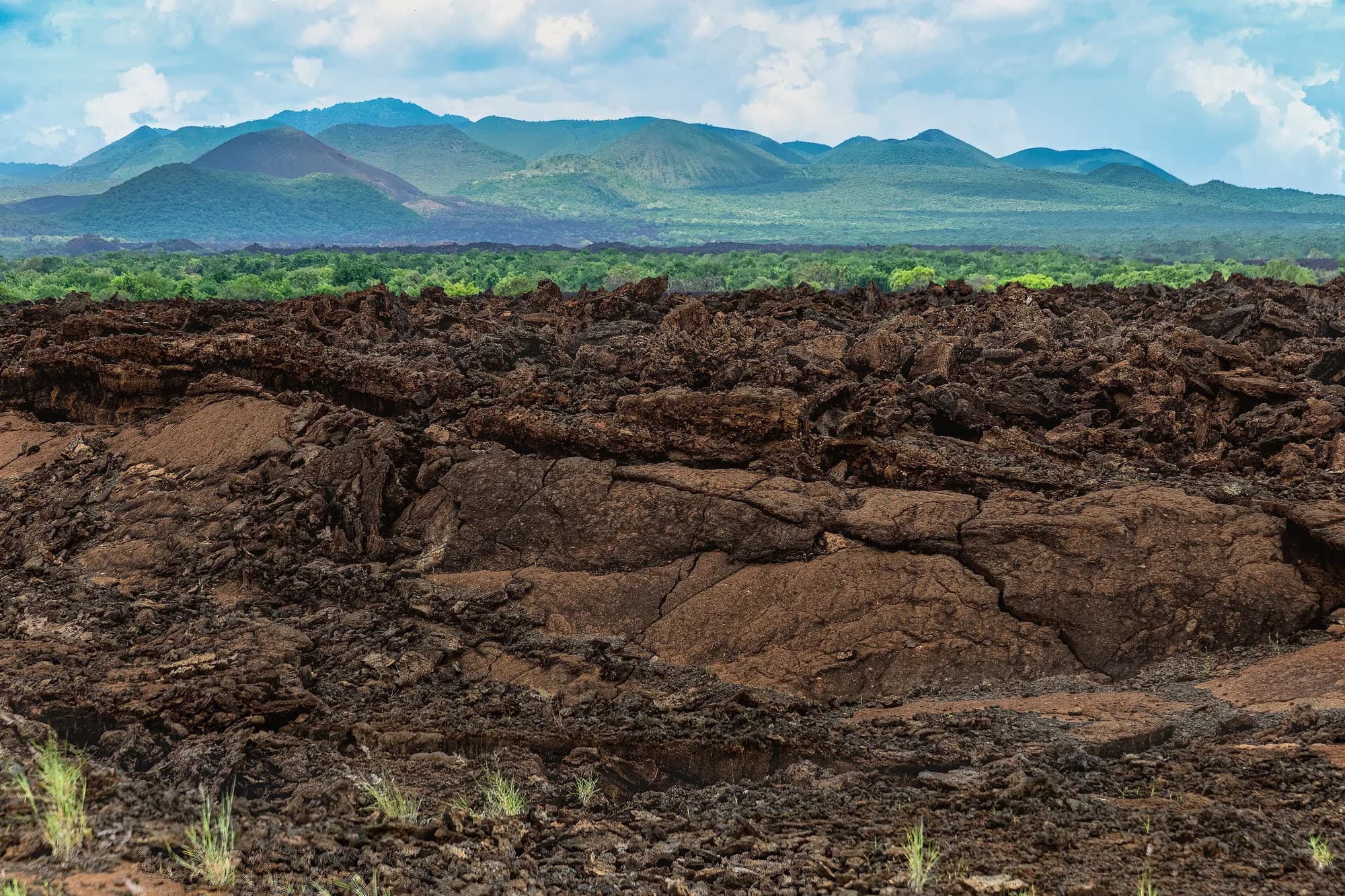
Read 28 September 2026. The factsheet names the site Tsavo West National Park, in Kenya, and gives an area of 7,327.91 square kilometres — which does not agree with the World Database on Protected Areas. It qualifies under criterion B2, and the trigger and qualifying species listed include the Near Threatened Mirafra pulpa and Crex crex, alongside Loxodonta africana (EN) and Diceros bicornis (CR). The habitat description gives Acacia-Commiphora bushland in the northern sectors, rocky outcrops, the Chyulu Hills with their ash cones and lava flows, open grassy plains in the south, riverine woodland along the Tsavo river, and extensive beds of Typha with large permanent swamps at Lake Jipe. On threats it states that the park faces no major threats at present, while listing nomadic grazing, fire suppression, invasive species, mining, drought and storms, and roads, railways and flight paths as ongoing concerns.
https://www.keybiodiversityareas.org/en/site/factsheet/6415The year, month by month
Month by month
| Months | Conditions | Worth knowing |
|---|---|---|
| January - February | Short dry season; hot, clear, dusty | Excellent light on the hills and the lava; the hottest driving of the year |
| March - May | Long rains; green, humid, very quiet | Thick cover at its worst for spotting; black cotton on southern routes; lowest rates |
| June - August | Long dry season; cooler mornings | The classic window, and the busiest at Mzima |
| September - October | Driest of the year | Best concentration at water; the bush thins and visibility improves markedly |
| Late November - early December | Short rains beginning; misty nights | The bird-ringing fall at Ngulia; see the section below |
| December | Short rains, then the Christmas peak | Green, good photography, busy beds |
The conservation fee does not change with any of this. A non-resident adult pays USD 80 in February and USD 80 in August. That is the opposite of the Maasai Mara, where the Narok County Finance Act 2023 prices a non-resident adult at USD 200 from 1 July to 31 December and USD 100 from 1 January to 30 June.
The flat fee has a consequence worth stating for this park specifically. Because Tsavo West's wet season is genuinely beautiful and its dry season is genuinely better for animals, and because neither costs more at the gate, the only financial signal you get is the bed rate — and the bed rate is telling you about demand, not about the park. September and October are the months where the two align: driest ground, thinnest bush, and the beds not yet at Christmas prices.
Kenya Wildlife Service — Conservation Fees, October 2025 schedule
Carried from the verified fee record this site holds against KWS's own published schedule, taken from the PDF above on 27 September 2026. We tried the department again on 28 September 2026 and the read failed at the same wall: the fee PDF returned a TLS certificate that could not be verified, and so did the department's own December 2025 press release on the rhino sanctuary. The figures here are therefore carried as recorded rather than re-read live, and no operator's copy of the tariff has been substituted for the department's — an operator's fee table is not a source, however confidently it is laid out. One caveat belongs on the face of the page rather than in a footnote: the schedule bands parks rather than naming a rate park by park, and Tsavo West sits in the band printed "WILDERNESS PARKS (A)", given on the document as "Tsavo East and Tsavo West National Parks". The mapping from that band to this park is the single step between the document and these tables.
https://kws.go.ke/wp-content/uploads/2026/05/KWS-Conservation-Fee-October-2025.pdfNarok County Finance Act 2023 (Kenya Gazette Supplement No. 7, Narok County Acts No. 3, 13 October 2023), First Schedule
Read 28 September 2026, and used here only for the Maasai Mara comparison. The First Schedule prices non-resident adult entry at USD 200 in high season, defined in the Act as 1 July to 31 December, and USD 100 in low season, 1 January to 30 June, against USD 80 in the 2022/2023 column. Children aged 9 to 17 and students are USD 50, and children of 8 and below are free. Vehicle entry is KSh 1,000 under six seats, KSh 1,500 for six to twelve and KSh 3,500 for thirteen to twenty-four. The Act defines park entry as an amount charged for entry from 6.00am to 6.00pm, time of entry notwithstanding. These are county fees set under this Act, not KWS fees, and the caveats about whether they remain current are set out in full on the Mara's own permits page.
https://narok.go.ke/wp-content/uploads/2025/10/Narok-County-Finance-Act-2023-1.pdfNovember and December at Ngulia, which is unique in Kenya
Every year since 1969, bird ringers from Europe and Kenya have met at Ngulia Safari Lodge to ring Palaearctic migratory songbirds — birds that breed in Europe and Asia and winter in Africa. Nature Kenya's account of it is plain about the mechanism: the birds pass through in November and December, and on dark, misty nights they become disoriented and land in the bush around the lights of the lodge. Mist, moonless nights and a lit building on a ridge in the flight path, and a scientific dataset falls out of it.
What the site has produced
| Period | Palaearctic migrants ringed | Afrotropical birds ringed |
|---|---|---|
| 1969 - 2020, cumulative | 597,694, of 72 species | 15,570, of 234 species |
| 2020 season | 10,666, of 32 species | 588, of 75 species |
| 24 November - 6 December 2024 | 13,328 birds in total including 966 residents, across 118 species | Included in the 13,328 |
The cumulative and 2020 figures are Nature Kenya's from its November 2021 account; the 2024 figures are Nature Kenya's report of that season, published January 2025 and written by Aloise Garvey. The 2020 season was ringed by the Kenyan team alone, because European participants could not travel under COVID-19 restrictions. The two totals are counted slightly differently and are not directly comparable, which is why they are on separate rows rather than in one series.
The 2024 list gives a flavour of what turns up: migratory Eurasian Scops Owl, corn crakes and a rare Lesser Cuckoo, alongside residents including Narina Trogon, Eastern Nicators and African Golden Orioles. The corn crake matters twice over, because Crex crex is also one of the species on the Key Biodiversity Areas factsheet's trigger list for the park as a whole.
How to use this as a visitor
If birds are the point, this is the two weeks and Ngulia is the place, and you are booking a specific lodge a long way in advance. If birds are not the point, know that a working ringing operation is a fine thing to stumble into and a slightly busy one to sleep next to. Either way, the dates move a little year to year with the moon and the weather, so ask rather than assuming late November.
Nature Kenya — Ngulia bird ringing
Read 28 September 2026. Nature Kenya states that every year since 1969 bird ringers from Europe and Kenya have met at Ngulia Safari Lodge in Tsavo West to ring Palaearctic migratory songbirds, that the birds pass through in November and December, and that on dark, misty nights the migrants become disoriented and land in the bush around the lights of the lodge. It gives 597,694 Palaearctic migratory birds of 72 species and 15,570 Afrotropical birds of 234 species ringed at the site over 1969 to 2020, and for the 2020 season 10,666 Palaearctic migrants of 32 species and 588 Afrotropical birds of 75 species, ringed by the Kenyan team alone because European participants could not travel under COVID-19 restrictions.
https://naturekenya.org/2021/11/01/ngulia-bird-ringing/Nature Kenya — Bird ringing in Ngulia, January 2025
Read 28 September 2026. Nature Kenya's report on the 2024 season at Ngulia Safari Lodge, written by Aloise Garvey. It gives the dates as 24 November to 6 December 2024, a total of 13,328 birds ringed including 966 of resident species, and 118 species recorded. Named birds include migratory Eurasian Scops Owl, Corn Crakes and a rare Lesser Cuckoo, alongside residents including Narina Trogon, Eastern Nicators and African Golden Orioles.
https://naturekenya.org/2025/01/14/bird-ringing-in-ngulia/Key Biodiversity Areas Partnership — Tsavo West National Park, site factsheet 6415
Read 28 September 2026. The factsheet names the site Tsavo West National Park, in Kenya, and gives an area of 7,327.91 square kilometres — which does not agree with the World Database on Protected Areas. It qualifies under criterion B2, and the trigger and qualifying species listed include the Near Threatened Mirafra pulpa and Crex crex, alongside Loxodonta africana (EN) and Diceros bicornis (CR). The habitat description gives Acacia-Commiphora bushland in the northern sectors, rocky outcrops, the Chyulu Hills with their ash cones and lava flows, open grassy plains in the south, riverine woodland along the Tsavo river, and extensive beds of Typha with large permanent swamps at Lake Jipe. On threats it states that the park faces no major threats at present, while listing nomadic grazing, fire suppression, invasive species, mining, drought and storms, and roads, railways and flight paths as ongoing concerns.
https://www.keybiodiversityareas.org/en/site/factsheet/6415What the rains do to lava, and what they do to black cotton
Tsavo West has two quite different problem surfaces and they fail in opposite ways. In the north the ground is volcanic — rock, ash and lava — which drains fast and does not turn to grease, so the northern triangle stays drivable through a wet week far better than Tsavo East's tracks do. What it does instead is become slippery on rock and cut up on the murram sections, and lava rock is unforgiving of a low sump.
In the south, on the open plains towards Jipe, there is black cotton, and black cotton behaves the way it behaves everywhere: hard when dry, a grease that will hold a two-tonne vehicle for hours when wet. The practical consequence is that in the long rains Tsavo West does not close but it shrinks to its northern half, and the southern sector becomes a thing you do not attempt without recovery gear and a reason.
What we could not verify
We hold no current KWS statement of which routes close in the wet, whether any of the six gates closes seasonally, or what the park's guidance is after heavy rain. That would come from the department's park page, which was unreadable to us on 28 September 2026. Ask at the gate on the way in — the answer genuinely changes with the state of the ground, so even a published list would be less useful than the question.
Mzima's own calendar, and the 2009 warning
Mzima is fed by an aquifer with a decades-long lag, so the springs themselves do not follow the rainy season the way a river does. What does follow the season is everything around them — how much other water there is in the park, how many animals are therefore concentrated at Mzima, and how much sediment is in the pools.
The springs through the year
| Period | The pools | The wildlife around them |
|---|---|---|
| Dry, June to October and January to February | Clearest, and lowest other water in the park | The highest concentration of everything at the springs |
| Wet, March to May and November | Greener surrounds, more inflow and sediment in the streams below | Animals dispersed; hippo still resident because the pools are permanent |
| After a severe drought | Water level a documented concern | The 2009 collapse, below |
The hippo are resident in the pools year-round because the pools are permanent. That is the whole argument for Mzima being a dry-season-proof stop, and it is why this is the one place in Tsavo West a wet-season visitor is not disadvantaged.
The 2009 collapse, which is the honest counterweight
Wikipedia records 70 hippos at Mzima in 2003 and only five remaining in September 2009, after the drought. Tsavo Trust's own account of the springs discusses the effect of that drought on the resident animals. We hold no more recent hippo count for Mzima from any source, so we cannot tell you what is there now and we are not going to imply a recovery we have not seen documented. A permanent spring is not the same as a permanent population.
Wikipedia — Mzima Springs
Read 28 September 2026, and flagged as an encyclopaedia rather than an authority because no departmental figure was reachable. It gives the source of the springs as a natural reservoir under the Chyulu Hills to the north, rainwater percolating through volcanic rock and spending up to 25 years underground before emerging 50 kilometres away at Mzima, and a supply of 20,000 cubic metres a day to Voi, Mariakani and the South Coast. On the hippos it gives 70 animals in 2003 and only five remaining in September 2009, after the drought. It describes the stream running through a series of pools and rapids before disappearing two kilometres downstream. It does not describe the underwater viewing chamber or its condition.
https://en.wikipedia.org/wiki/Mzima_SpringsTsavo Trust — Mzima Springs: clear waters and the impact of hippos
Read 28 September 2026. The Trust describes the Chyulu Hills as a mountain range constituting a 100-kilometre-long volcanic field, states that the water can remain subterranean for up to 25 years before emerging at Mzima, and confirms that the springs carry an underwater viewing tank from which visitors can watch aquatic life. It sets out the role of hippo dung in the food chain and the effect of the 2009 drought on the resident animals. It publishes no daily output figure, no dimensions for the viewing chamber and no statement of its current condition.
https://tsavotrust.org/mzima-springs-clear-waters-and-the-impact-of-hippos/Choosing, if you only get one visit
- The best combination available here: September or October. Driest ground, thinnest bush, strongest concentration at water, beds not yet at peak.
- For the landscape above everything: late December through February, when the light is hard and clear on the lava and the hills.
- For birds: late November into early December, at Ngulia, booked a long way ahead.
- For cheapness and solitude: April and May, accepting the thickest cover of the year and a southern sector you should not attempt.
- For the classic trip with the most company: July and August, when the Mzima car park is at its busiest.
- The month to avoid without a specific reason: April, for the same reason as at Tsavo East, though less severely.
If the choice is between a short dry trip and a longer wet one, the answer here is the opposite of Tsavo East's. There, take the short dry trip, because extra days in the wet buy more of a park with the animals hidden. Here the park is small enough that extra days genuinely help, and the wet-season penalty is cover rather than dispersal — so a longer green trip with a good guide is a reasonable choice, and it will be the better-looking holiday.