
Kenya / Tsavo West / Wildlife — Tsavo West
Wildlife — Tsavo West
Tsavo West holds animals Tsavo East does not — rhino above all — and shows you fewer of everything else. The reason is not density, which is the Tsavo East argument, but cover, and cover is the harder problem because no amount of driving solves it.
Cover, not density, and why that is worse
Tsavo East's wildlife page makes its case arithmetically: more elephants than anywhere in Kenya, spread across so much ground that you meet fewer of them per hour than at Amboseli. That argument is about distance and the remedy is time and water knowledge. Tsavo West's problem is different and it is not soluble by driving further.
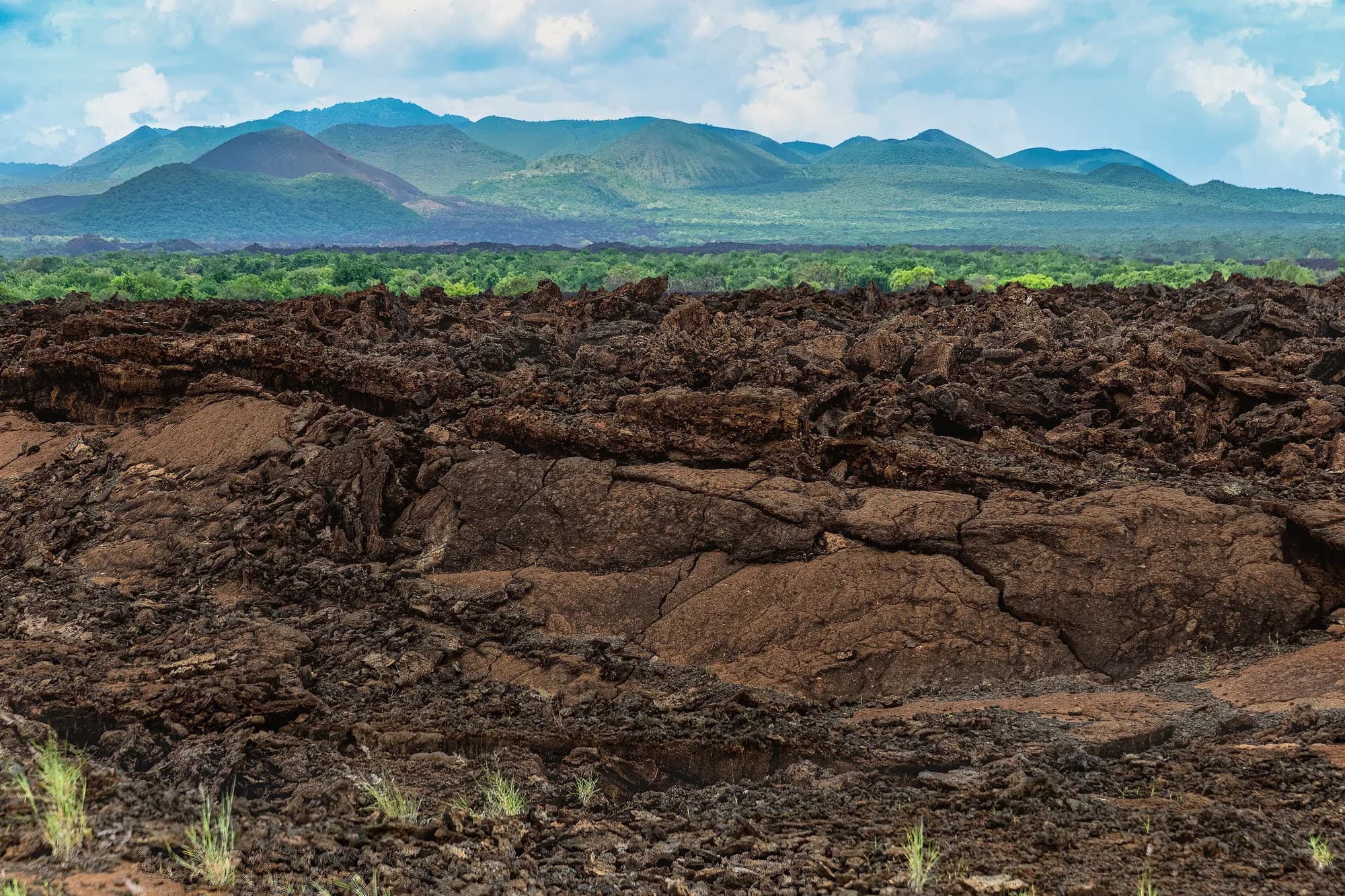
The Key Biodiversity Areas factsheet describes the northern sectors of this park as Acacia-Commiphora bushland with rocky outcrops, and open grassy plains only in the south. Commiphora bush is grey, dense, thorny and about the height of a large animal. A bull elephant standing forty metres off a track in it is invisible. You do not miss him because he is far away, which you could fix; you miss him because there is a bush in the way, which you cannot.
Three Kenyan parks, three different reasons a morning can be quiet
| Park | The constraint | What fixes it |
|---|---|---|
| Amboseli | Almost nothing; the park is small and open | Nothing needs fixing |
| Tsavo East | Distance. The animals are spread over 11,747 sq km | Time, and knowing where the water is |
| Tsavo West | Cover. Thick bushland hides animals at close range | A guide who knows the ground, first light, and patience at water |
Areas are the WDPA's, read 28 September 2026. The constraints are our reading of why each park behaves as it does, and the table is editorial rather than a published comparison.
The sentence to take away
At Tsavo East a good driver covers ground. At Tsavo West a good guide stops the vehicle and points at something you were looking straight at. If you are going to spend money on one thing at this park, that is the thing, and the booking page says so at length.
Key Biodiversity Areas Partnership — Tsavo West National Park, site factsheet 6415
Read 28 September 2026. The factsheet names the site Tsavo West National Park, in Kenya, and gives an area of 7,327.91 square kilometres — which does not agree with the World Database on Protected Areas. It qualifies under criterion B2, and the trigger and qualifying species listed include the Near Threatened Mirafra pulpa and Crex crex, alongside Loxodonta africana (EN) and Diceros bicornis (CR). The habitat description gives Acacia-Commiphora bushland in the northern sectors, rocky outcrops, the Chyulu Hills with their ash cones and lava flows, open grassy plains in the south, riverine woodland along the Tsavo river, and extensive beds of Typha with large permanent swamps at Lake Jipe. On threats it states that the park faces no major threats at present, while listing nomadic grazing, fire suppression, invasive species, mining, drought and storms, and roads, railways and flight paths as ongoing concerns.
https://www.keybiodiversityareas.org/en/site/factsheet/6415UNEP-WCMC, World Database on Protected Areas — Tsavo West, WDPA site 19564
Read 28 September 2026. Protected Planet gives Tsavo West a reported area of 9,065.0 square kilometres. Tsavo East, on site 752, was read the same day and is given as 11,747.0 square kilometres. Both are the WDPA's reported-area field and neither was readable from Kenya Wildlife Service itself, because kws.go.ke refused us on 28 September 2026.
https://www.protectedplanet.net/19564Rhino, and what December 2025 did to the odds
Rhino is the species Tsavo West has and Tsavo East does not, and it is the single strongest reason to choose this park over its twin. The Key Biodiversity Areas factsheet lists Diceros bicornis, the black rhino, as Critically Endangered among the species the site supports. What has changed, and changed very recently, is where they are and therefore how you might see one.
The rhino numbers, and what each one is
| Figure | Source | What kind of claim |
|---|---|---|
| 2,102 rhino nationally | WRTI, census June 2024 to August 2025, published 12 December 2025 | A national census figure, against 1,812 in 2021 |
| About 2,100 nationally: 1,060 black, 1,040 southern white, 2 northern white | The Star, reporting the sanctuary launch, 9 December 2025 | A press report of the split, published three days before the census release |
| 200 black rhino | Save the Rhino International | The founder population of the new Tsavo West sanctuary: 150 from Ngulia plus 50 from the Intensive Protection Zone |
| 78 per cent of the global eastern black rhino population | The Star, 9 December 2025 | Kenya's share, as reported at the launch |
| 1,450 black rhino by 2030; 2,000 rhino by 2037 | The Star, 9 December 2025 | National targets, with the annual black rhino growth rate to rise from 5 to 8 per cent |
The WRTI total of 2,102 and the Star's about 2,100 are close enough to be the same figure reported twice; they are tabled separately because they were published by different bodies on different days and only one of them is a census. Neither breaks out a Tsavo West count, and no park-level rhino number appears on these pages.
What that honestly does to your chances
Two hundred black rhino is, on Save the Rhino International's account, the largest single black rhino population in Kenya. Against that, the sanctuary they now live in is more than 3,200 square kilometres — about a third of Tsavo West on the WDPA area figure — where the old Ngulia sanctuary was 92. The population went up and the density went down by a factor of more than thirty, so a visitor's chances went down with it, and anyone telling you otherwise is selling something. The conservation case is excellent: Save the Rhino International states plainly that the old sanctuary had exceeded its ecological carrying capacity, which limited breeding and survival. But the odds of a rhino sighting in 3,200 square kilometres of bushland are not the odds in a 92 square kilometre fenced enclosure. If reliable rhino viewing is the object of your Kenyan trip, the fenced parks are where that happens, and this site says so on their pages. Come here for a wild rhino you might not find, not a rhino you will.
Save the Rhino International — Groundbreaking expansion of Tsavo West Rhino Sanctuary in Kenya
Read 28 September 2026. Save the Rhino International is a partner in the Kenya Rhino Range Expansion programme, which is why its account is used here rather than an operator's. It gives the opening date as 9 December 2025; the former Ngulia Rhino Sanctuary as 92 square kilometres; the new Tsavo West Rhino Sanctuary as 3,200 square kilometres; 150 black rhinos from Ngulia merging with 50 from the Tsavo West Intensive Protection Zone to form a founder population of 200, described as the largest single black rhino population in Kenya; and states that for many years the 92 square kilometre Ngulia sanctuary exceeded its ecological carrying capacity, which limited breeding and survival.
https://www.savetherhino.org/africa/pioneering-tsavo-west-rhino-sanctuary-opens-in-kenya/The Star (Kenya) — Ruto launches world's largest rhino sanctuary in Tsavo West, 9 December 2025
Read 28 September 2026. A Kenyan newspaper report of the launch, used because Kenya Wildlife Service's own press release on the same event was unreadable to us — kws.go.ke returned a TLS certificate that could not be verified on 28 September 2026, for both the HTML release and the PDF of it. The report gives the sanctuary as more than 3,200 square kilometres with more than 250 kilometres of upgraded fencing; 90 rhinos immobilised and 89 fitted with tracking devices; 40 new ranger houses and operational bases and more than 300 security personnel; USD 4.7 million, given as Sh606 million, invested in protection systems; national targets of 1,450 black rhinos by 2030 and 2,000 rhinos by 2037, with the annual black rhino growth rate to rise from 5 to 8 per cent; and projections of more than 18,000 jobs and USD 45 million, given as Sh5.8 billion, in tourism and conservancy revenue by 2030. On national rhino numbers it gives about 2,100 in total — 1,060 black, 1,040 southern white and the world's last two northern white — and states that Kenya holds 78 per cent of the global eastern black rhino population. It carries nothing about visitor access to the sanctuary.
https://www.the-star.co.ke/news/2025-12-09-ruto-launches-worlds-largest-rhino-sanctuary-in-tsavo-westWildlife Research and Training Institute — Wildlife census shows elephant recovery but alarming drop in rare species
Read 28 September 2026. WRTI's release on the National Wildlife Census covering June 2024 to August 2025 and published on 12 December 2025. National totals: elephants 41,952 against 36,280 in 2021; rhino 2,102 against 1,812; giraffe 43,002 against 35,355; hirola 245; Grevy's zebra 2,465; sable antelope 40 against 51 in 2021. The release carries national figures and does not break out a Tsavo West count for any species, which is why no park-level animal number appears on these pages. It recommends wildlife corridors between major ecosystems and names the Tsavo-Amboseli link specifically.
https://wrti.go.ke/?p=8259Key Biodiversity Areas Partnership — Tsavo West National Park, site factsheet 6415
Read 28 September 2026. The factsheet names the site Tsavo West National Park, in Kenya, and gives an area of 7,327.91 square kilometres — which does not agree with the World Database on Protected Areas. It qualifies under criterion B2, and the trigger and qualifying species listed include the Near Threatened Mirafra pulpa and Crex crex, alongside Loxodonta africana (EN) and Diceros bicornis (CR). The habitat description gives Acacia-Commiphora bushland in the northern sectors, rocky outcrops, the Chyulu Hills with their ash cones and lava flows, open grassy plains in the south, riverine woodland along the Tsavo river, and extensive beds of Typha with large permanent swamps at Lake Jipe. On threats it states that the park faces no major threats at present, while listing nomadic grazing, fire suppression, invasive species, mining, drought and storms, and roads, railways and flight paths as ongoing concerns.
https://www.keybiodiversityareas.org/en/site/factsheet/6415Elephant, shared with the park next door
The Key Biodiversity Areas factsheet lists Loxodonta africana as Endangered among the species this site supports, and the elephants here are the same population as Tsavo East's — one ecosystem, two parks, animals that do not read the gazette. Tsavo East's wildlife page carries the elephant numbers, the disagreement between the three organisations that publish them, and the big-tusker material, and none of it is repeated here because none of it is different.
What is different is the experience. Tsavo East's elephants are red, because the soil there is fine red laterite and they wear it. Tsavo West's soil is volcanic and darker, and its elephants are correspondingly less spectacular in a photograph and considerably harder to find in commiphora scrub. A party doing both parks in one trip will almost always report better elephant viewing in the east, and that is the correct report.
The corridor point, which is this park's rather than the other one's
WRTI's December 2025 census release recommends creating wildlife corridors between major ecosystems and names the Tsavo-Amboseli link specifically. That link runs through Tsavo West's western side and the Chyulu country, not through Tsavo East. When people talk about connecting the two great southern elephant populations, this park is the ground it happens on, and the Kimana corridor that Amboseli's pages describe is the other end of the same line.
Wildlife Research and Training Institute — Wildlife census shows elephant recovery but alarming drop in rare species
Read 28 September 2026. WRTI's release on the National Wildlife Census covering June 2024 to August 2025 and published on 12 December 2025. National totals: elephants 41,952 against 36,280 in 2021; rhino 2,102 against 1,812; giraffe 43,002 against 35,355; hirola 245; Grevy's zebra 2,465; sable antelope 40 against 51 in 2021. The release carries national figures and does not break out a Tsavo West count for any species, which is why no park-level animal number appears on these pages. It recommends wildlife corridors between major ecosystems and names the Tsavo-Amboseli link specifically.
https://wrti.go.ke/?p=8259Key Biodiversity Areas Partnership — Tsavo West National Park, site factsheet 6415
Read 28 September 2026. The factsheet names the site Tsavo West National Park, in Kenya, and gives an area of 7,327.91 square kilometres — which does not agree with the World Database on Protected Areas. It qualifies under criterion B2, and the trigger and qualifying species listed include the Near Threatened Mirafra pulpa and Crex crex, alongside Loxodonta africana (EN) and Diceros bicornis (CR). The habitat description gives Acacia-Commiphora bushland in the northern sectors, rocky outcrops, the Chyulu Hills with their ash cones and lava flows, open grassy plains in the south, riverine woodland along the Tsavo river, and extensive beds of Typha with large permanent swamps at Lake Jipe. On threats it states that the park faces no major threats at present, while listing nomadic grazing, fire suppression, invasive species, mining, drought and storms, and roads, railways and flight paths as ongoing concerns.
https://www.keybiodiversityareas.org/en/site/factsheet/6415Hippo and crocodile at Mzima, and the collapse nobody mentions
Mzima Springs is the one place in either Tsavo where hippo and crocodile are the point rather than an incidental at a river bend. The pools are permanent, spring-fed and clear, and Tsavo Trust confirms both species are resident and that there is an underwater viewing tank from which visitors can watch aquatic life. Tsavo Trust also sets out the ecology that makes the place work: hippo dung is the base of the food chain in the pools, which is why the fish are there in the numbers they are.
The hippo at Mzima, as documented
| Year | Hippo | Source |
|---|---|---|
| 2003 | 70 | Wikipedia |
| September 2009 | Only five remained, after the drought | Wikipedia |
| Since | No count we could source | — |
Wikipedia is an encyclopaedia rather than an authority and is flagged as such here; it is used because no departmental or research figure for Mzima's hippo population was reachable on 28 September 2026. We hold nothing more recent than 2009 and we are not going to imply a recovery we have not seen documented.
That gap is the most important thing on this section. A visitor is told Mzima means hippos, arrives at a viewing chamber, and either sees them or does not — and there is no published number anywhere we could find that would let anyone set an expectation honestly. A population that fell from seventy to five within six years is a population that can be at any figure now, and the springs are permanent in a way the animals are not.
Crocodile, which is the more reliable of the two
Nile crocodile are resident and are what most visitors actually see from the walkway, alongside the fish. They are less photogenic than a hippo and they are the animal that makes the marked path a marked path. Stay on it.
Tsavo Trust — Mzima Springs: clear waters and the impact of hippos
Read 28 September 2026. The Trust describes the Chyulu Hills as a mountain range constituting a 100-kilometre-long volcanic field, states that the water can remain subterranean for up to 25 years before emerging at Mzima, and confirms that the springs carry an underwater viewing tank from which visitors can watch aquatic life. It sets out the role of hippo dung in the food chain and the effect of the 2009 drought on the resident animals. It publishes no daily output figure, no dimensions for the viewing chamber and no statement of its current condition.
https://tsavotrust.org/mzima-springs-clear-waters-and-the-impact-of-hippos/Wikipedia — Mzima Springs
Read 28 September 2026, and flagged as an encyclopaedia rather than an authority because no departmental figure was reachable. It gives the source of the springs as a natural reservoir under the Chyulu Hills to the north, rainwater percolating through volcanic rock and spending up to 25 years underground before emerging 50 kilometres away at Mzima, and a supply of 20,000 cubic metres a day to Voi, Mariakani and the South Coast. On the hippos it gives 70 animals in 2003 and only five remaining in September 2009, after the drought. It describes the stream running through a series of pools and rapids before disappearing two kilometres downstream. It does not describe the underwater viewing chamber or its condition.
https://en.wikipedia.org/wiki/Mzima_SpringsBirds, and half a million ringed migrants
Tsavo West is a serious bird site and it is the only park on this site that can prove it with a dataset. The Key Biodiversity Areas factsheet qualifies the park under criterion B2, and its trigger species include the Near Threatened Mirafra pulpa — the Friedmann's lark, a bird that turns up in numbers only in some years — and Crex crex, the corn crake, a Palaearctic migrant.
The proof is at Ngulia. Nature Kenya records 597,694 Palaearctic migratory birds of 72 species and 15,570 Afrotropical birds of 234 species ringed at the site between 1969 and 2020. That is not a birdwatching claim; it is half a million individual birds in the hand, over fifty-one seasons, at one lodge on one ridge. There is no comparable figure for any other site in Kenya on this site's pages.
- The mechanism: dark, moonless, misty November and December nights, with the lodge's lights on a ridge in the migrants' flight path bringing them down into the surrounding bush.
- The season: November and December, with the 2024 operation running 24 November to 6 December.
- The scale of one modern season: 13,328 birds across 118 species in 2024, of which 966 were residents.
- The species that make it: warblers, shrikes and chats in bulk, with rarities such as the Lesser Cuckoo recorded in 2024, and Eurasian Scops Owl and corn crakes among the migrants.
- The residents that make the rest of the year worth a birder's time: Narina Trogon, Eastern Nicators and African Golden Orioles were all recorded in the 2024 season.
- Lake Jipe in the south, with its Typha beds and permanent swamp, which is the park's water-bird habitat and a completely different list.
Nature Kenya — Ngulia bird ringing
Read 28 September 2026. Nature Kenya states that every year since 1969 bird ringers from Europe and Kenya have met at Ngulia Safari Lodge in Tsavo West to ring Palaearctic migratory songbirds, that the birds pass through in November and December, and that on dark, misty nights the migrants become disoriented and land in the bush around the lights of the lodge. It gives 597,694 Palaearctic migratory birds of 72 species and 15,570 Afrotropical birds of 234 species ringed at the site over 1969 to 2020, and for the 2020 season 10,666 Palaearctic migrants of 32 species and 588 Afrotropical birds of 75 species, ringed by the Kenyan team alone because European participants could not travel under COVID-19 restrictions.
https://naturekenya.org/2021/11/01/ngulia-bird-ringing/Nature Kenya — Bird ringing in Ngulia, January 2025
Read 28 September 2026. Nature Kenya's report on the 2024 season at Ngulia Safari Lodge, written by Aloise Garvey. It gives the dates as 24 November to 6 December 2024, a total of 13,328 birds ringed including 966 of resident species, and 118 species recorded. Named birds include migratory Eurasian Scops Owl, Corn Crakes and a rare Lesser Cuckoo, alongside residents including Narina Trogon, Eastern Nicators and African Golden Orioles.
https://naturekenya.org/2025/01/14/bird-ringing-in-ngulia/Key Biodiversity Areas Partnership — Tsavo West National Park, site factsheet 6415
Read 28 September 2026. The factsheet names the site Tsavo West National Park, in Kenya, and gives an area of 7,327.91 square kilometres — which does not agree with the World Database on Protected Areas. It qualifies under criterion B2, and the trigger and qualifying species listed include the Near Threatened Mirafra pulpa and Crex crex, alongside Loxodonta africana (EN) and Diceros bicornis (CR). The habitat description gives Acacia-Commiphora bushland in the northern sectors, rocky outcrops, the Chyulu Hills with their ash cones and lava flows, open grassy plains in the south, riverine woodland along the Tsavo river, and extensive beds of Typha with large permanent swamps at Lake Jipe. On threats it states that the park faces no major threats at present, while listing nomadic grazing, fire suppression, invasive species, mining, drought and storms, and roads, railways and flight paths as ongoing concerns.
https://www.keybiodiversityareas.org/en/site/factsheet/6415Realistic odds
Over three or four game drives in the dry season, mostly in the northern sector
| Animal | Odds | Where |
|---|---|---|
| Hippopotamus | High at Mzima, and effectively nowhere else | The springs; from the walkway and the chamber |
| Nile crocodile | High at Mzima | The pools and the stream below them |
| African elephant | High | Water points and open ground; harder to spot in bush than at Tsavo East |
| Impala, waterbuck, dik-dik | High | Throughout; dik-dik constantly in the scrub |
| Common zebra and buffalo | High | Open ground, the southern plains, at water |
| Maasai giraffe | High | Acacia country and the more open north |
| Lesser kudu | Moderate | Dense commiphora; better here than at most Kenyan parks and still brief |
| African lion | Moderate | First and last light; often heard rather than seen |
| Spotted hyena | Moderate | Open ground and around water at dusk |
| Water birds | High at Lake Jipe, low elsewhere | The southern sector only |
| Klipspringer | Low to moderate | Rocky outcrops and the lava country |
| Black rhino | Low | The sanctuary is now 3,200 sq km; this is not the enclosure it was |
| African leopard | Low | Rocky ground and riverine thicket; the cover works against you |
| Cheetah | Low | The open southern plains, not the bush |
In the wet season shift every land mammal down a band, because the cover thickens and the animals are no longer tied to water. Mzima's hippo and crocodile are the exception and do not move with the season. This table is editorial judgement from how the park behaves; only the rhino sanctuary area carries a source, above.
Read against Tsavo East's equivalent table the differences are instructive and they run both ways. Tsavo East gives better elephant, better open-country viewing and the dry-country antelope — gerenuk and fringe-eared oryx — that this park does not reliably produce. Tsavo West gives rhino, hippo and crocodile at close quarters, lesser kudu more often, and klipspringer on rock that Tsavo East does not have. Neither park will give you a reliable leopard or a reliable cheetah.
What Tsavo West does not have
- Easy game viewing. This is the honest headline of the page. The park is beautiful and the animals are behind a bush.
- Tsavo East's elephant experience. Same population, less open ground, darker animals, fewer of them per hour.
- Reliable rhino viewing, and less of it than in 2024. The expansion is good for rhino and bad for rhino sightings.
- Kilimanjaro as Amboseli has it. The mountain is visible from parts of the park on a clear morning, but Amboseli is where that view is the product.
- Density of any kind. If animals per hour is the measure, Amboseli and the Maasai Mara are the answer and the price difference is what you are paying for.
- A migration. There is no seasonal herd movement here, and the only thing that arrives on a schedule is the birds.
- Predator theatre. Lion are present and are heard more than seen; cheetah belong to the southern plains and are a genuine piece of luck.
- African wild dog, effectively, as across most of Kenya.
Stated positively: Tsavo West is a landscape park with rhino in it, a spring that behaves like nothing else in Kenya, and a bird site of continental importance. Book it as that and it is one of the best parks in the country. Book it as Tsavo East with better views and it will quietly disappoint you for three days.