
Kenya / Tsavo West / Sightings log — Tsavo West
Sightings log — Tsavo West
This site does not run a moderated sightings log for Tsavo West. What it can do is set out honestly what this park gives people and what it takes away — and the pattern is unusually consistent: they come back with better photographs of scenery than of animals, and they are usually glad.
No log, and why we will not fake one
A sightings log is worth something only when it is moderated and carries volume. A short list of unverified reports looks like data and behaves like advertising, and it is the easiest thing on a site like this one to fabricate. We have not collected that for Tsavo West and we will not publish the appearance of it.
There is one exception on this park and it is not ours. The Ngulia ringing operation has produced a continuous, published, species-level record of what passes through this park every November and December since 1969 — 597,694 Palaearctic migrants of 72 species and 15,570 Afrotropical birds of 234 species by 2020, on Nature Kenya's figures. That is a real sightings log, kept by people who caught each bird, and it is the only one this park has.
Nature Kenya — Ngulia bird ringing
Read 28 September 2026. Nature Kenya states that every year since 1969 bird ringers from Europe and Kenya have met at Ngulia Safari Lodge in Tsavo West to ring Palaearctic migratory songbirds, that the birds pass through in November and December, and that on dark, misty nights the migrants become disoriented and land in the bush around the lights of the lodge. It gives 597,694 Palaearctic migratory birds of 72 species and 15,570 Afrotropical birds of 234 species ringed at the site over 1969 to 2020, and for the 2020 season 10,666 Palaearctic migrants of 32 species and 588 Afrotropical birds of 75 species, ringed by the Kenyan team alone because European participants could not travel under COVID-19 restrictions.
https://naturekenya.org/2021/11/01/ngulia-bird-ringing/Why the park photographs better than it scores
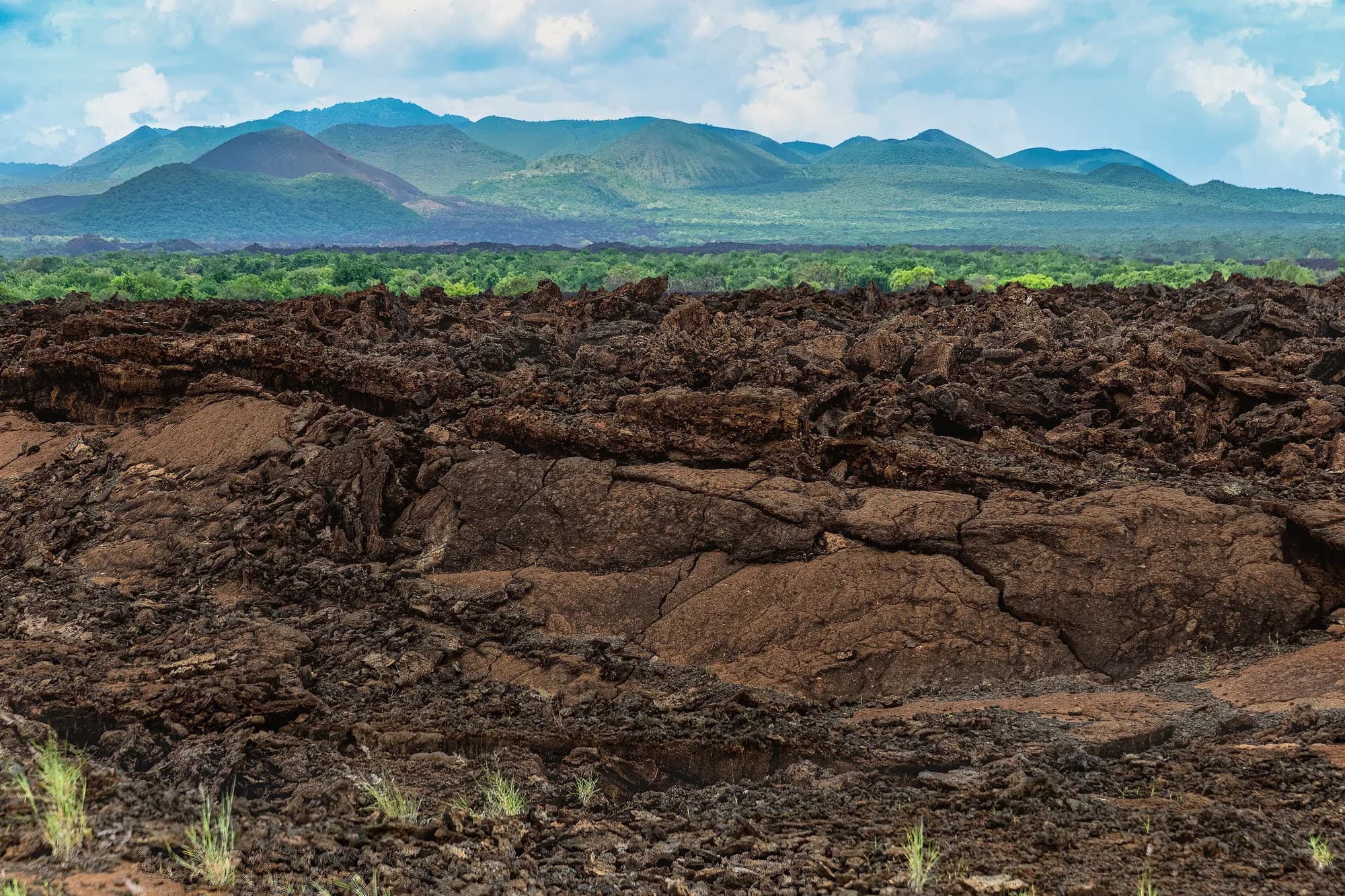
The consistent pattern in what people report about Tsavo West is that the landscape exceeded expectations and the wildlife did not. That is not two opinions; it is one fact seen twice. The volcanic, hilly, bush-covered country that makes the park beautiful is the same country that hides the animals in it.
The same trip, at three Kenyan parks
| Tsavo West | Tsavo East | Amboseli | |
|---|---|---|---|
| Reported area | 9,065 sq km on WDPA, 7,327.91 on the KBA factsheet | 11,747 sq km on WDPA | About 392 sq km, the figure this site carries |
| Terrain | Volcanic hills, lava, thick bushland | Flat open thorn scrub | Open plain, swamps, a lake bed |
| Why a sighting is missed | Cover. It was thirty metres away | Distance. It was ten kilometres away | Rarely missed |
| What a quiet hour means | Normal; the bush is doing its job | Normal, and the reason to come | Unusual |
| What people photograph | Landscape, lava, Mzima, the hills | Red elephants and empty tracks | Elephants and a mountain |
| What they say afterwards | Beautiful, but we did not see much | Empty, but we will not forget the space | We saw everything |
The bottom row is the honest summary of hundreds of trip reports. Read the Tsavo West column before you book rather than after, and the park will meet you where you are.
Tsavo East's sightings page has to defend that park against the charge of being empty, and the defence is arithmetic — it is not empty, it is enormous. Tsavo West needs no such defence and cannot use that one. It is not empty and it is not enormous. It is simply thick, and thick is a harder thing to explain to somebody who has just spent three days in it seeing dik-dik.
UNEP-WCMC, World Database on Protected Areas — Tsavo West, WDPA site 19564
Read 28 September 2026. Protected Planet gives Tsavo West a reported area of 9,065.0 square kilometres. Tsavo East, on site 752, was read the same day and is given as 11,747.0 square kilometres. Both are the WDPA's reported-area field and neither was readable from Kenya Wildlife Service itself, because kws.go.ke refused us on 28 September 2026.
https://www.protectedplanet.net/19564Key Biodiversity Areas Partnership — Tsavo West National Park, site factsheet 6415
Read 28 September 2026. The factsheet names the site Tsavo West National Park, in Kenya, and gives an area of 7,327.91 square kilometres — which does not agree with the World Database on Protected Areas. It qualifies under criterion B2, and the trigger and qualifying species listed include the Near Threatened Mirafra pulpa and Crex crex, alongside Loxodonta africana (EN) and Diceros bicornis (CR). The habitat description gives Acacia-Commiphora bushland in the northern sectors, rocky outcrops, the Chyulu Hills with their ash cones and lava flows, open grassy plains in the south, riverine woodland along the Tsavo river, and extensive beds of Typha with large permanent swamps at Lake Jipe. On threats it states that the park faces no major threats at present, while listing nomadic grazing, fire suppression, invasive species, mining, drought and storms, and roads, railways and flight paths as ongoing concerns.
https://www.keybiodiversityareas.org/en/site/factsheet/6415Mzima, and whether the chamber shows anything
The underwater viewing chamber at Mzima Springs is the single most photographed idea about this park and the one we can say least about with confidence, so here is exactly what we know and exactly what we do not.
- It exists. Tsavo Trust, which works in this ecosystem, states that the springs carry an underwater viewing tank and that visitors can use it to watch aquatic life.
- Hippo and Nile crocodile are resident in the pools, and Tsavo Trust sets out the ecology — hippo dung feeding the fish — that explains why there is anything to look at underwater at all.
- The hippo population has been through a documented collapse. Wikipedia records 70 animals in 2003 and only five in September 2009 after the drought, and we could source no count since.
- What the chamber shows on a given day depends on where the hippos are in the pool system, on the water clarity, and on whether the structure is in service.
- We hold no statement from any authority about the chamber's current condition, and kws.go.ke — which is where such a statement would live — returned a TLS certificate that could not be verified on 28 September 2026.
So the honest answer is: we cannot tell you
We are not going to promise you hippos through glass and we are not going to repeat a traveller review as though it were a departmental notice. What we can say is that the walk is worth doing whatever the chamber is showing, because the pools, the fish, the fig trees and the clarity of the water are the experience and the chamber is one stop on it. Arrive at first light, allow an hour rather than fifteen minutes, and treat the chamber as a possibility rather than the reason you came.
Tsavo Trust — Mzima Springs: clear waters and the impact of hippos
Read 28 September 2026. The Trust describes the Chyulu Hills as a mountain range constituting a 100-kilometre-long volcanic field, states that the water can remain subterranean for up to 25 years before emerging at Mzima, and confirms that the springs carry an underwater viewing tank from which visitors can watch aquatic life. It sets out the role of hippo dung in the food chain and the effect of the 2009 drought on the resident animals. It publishes no daily output figure, no dimensions for the viewing chamber and no statement of its current condition.
https://tsavotrust.org/mzima-springs-clear-waters-and-the-impact-of-hippos/Wikipedia — Mzima Springs
Read 28 September 2026, and flagged as an encyclopaedia rather than an authority because no departmental figure was reachable. It gives the source of the springs as a natural reservoir under the Chyulu Hills to the north, rainwater percolating through volcanic rock and spending up to 25 years underground before emerging 50 kilometres away at Mzima, and a supply of 20,000 cubic metres a day to Voi, Mariakani and the South Coast. On the hippos it gives 70 animals in 2003 and only five remaining in September 2009, after the drought. It describes the stream running through a series of pools and rapids before disappearing two kilometres downstream. It does not describe the underwater viewing chamber or its condition.
https://en.wikipedia.org/wiki/Mzima_SpringsWhat disappoints
- The game viewing, overwhelmingly, and almost always reported by somebody who came from Amboseli or the Mara three days earlier.
- Mzima at midday, which is when most commercial itineraries deliver you there, and which is the wrong two hours of the day for it.
- The chamber, when there is nothing in front of it. See above; nobody warns people that this is possible.
- Rhino. The expansion of the sanctuary in December 2025 is excellent conservation and it has made a sighting harder, and itineraries written before that still promise the old enclosure.
- The elephants, for anyone who did Tsavo East first. Same animals, darker, behind bushes, and fewer per hour.
- Distance to Lake Jipe, discovered by people who asked for it on the morning of day two.
- The realisation that Chyulu Hills is a separate national park with a separate fee, discovered at a gate.
Five of those seven are expectation or itinerary problems rather than park problems, and all five are fixable at the point of booking for less money than the trip already cost. The other two — the cover, and the rhino odds after December 2025 — are facts about the park as it is, and the right response to a fact is to know it in advance.
Save the Rhino International — Groundbreaking expansion of Tsavo West Rhino Sanctuary in Kenya
Read 28 September 2026. Save the Rhino International is a partner in the Kenya Rhino Range Expansion programme, which is why its account is used here rather than an operator's. It gives the opening date as 9 December 2025; the former Ngulia Rhino Sanctuary as 92 square kilometres; the new Tsavo West Rhino Sanctuary as 3,200 square kilometres; 150 black rhinos from Ngulia merging with 50 from the Tsavo West Intensive Protection Zone to form a founder population of 200, described as the largest single black rhino population in Kenya; and states that for many years the 92 square kilometre Ngulia sanctuary exceeded its ecological carrying capacity, which limited breeding and survival.
https://www.savetherhino.org/africa/pioneering-tsavo-west-rhino-sanctuary-opens-in-kenya/What exceeds expectations
Almost always the country, and specifically the moment somebody realises that the black rock they have been driving past for twenty minutes is a lava flow two hundred and forty years old. Tsavo Trust gives the Shetani flow as 8 kilometres long, 1.6 wide and 5 metres deep, and names it from the Swahili for devil. People arrive expecting a park and find a piece of geology still cooling.
- Mzima at first light, with nobody else on the walkway and the water so clear that the depth is unreadable.
- The Shetani flow, and the fact that you may walk on it. Almost nobody is told in advance that this is a landscape you get out and stand in.
- The Roaring Rocks, from which the whole park's geography resolves into one view in about four seconds.
- Chaimu, which is a short walk up a cinder cone and is the only place in either Tsavo you get that kind of height under your own feet.
- The Chyulu Hills, green and folded on the western horizon, which look like nowhere else in Kenya and are a different national park entirely.
- The birds, for anybody who did not come for birds. This is a site that has ringed close to six hundred thousand migrants, and it shows even in an ordinary week.
- The absence of other vehicles, everywhere except the Mzima car park.
The pattern is worth naming because it predicts who enjoys this park. People who arrived with a species checklist tend to leave mildly disappointed and with beautiful photographs. People who arrived for the country leave delighted and mention the rhino they did not see as a joke rather than a grievance. Tsavo West rewards the second kind of visitor and there is no shame in discovering which kind you are before you book.
Tsavo Trust — Four of the Tsavo Conservation Area's most spectacular topographical phenomena
Read 28 September 2026. The Shetani lava flow is given as 8 kilometres long, 1.6 wide and 5 metres deep, formed 240 years ago, with shetani given as the Swahili for devil. Mzima Springs is given as around 48 kilometres from Mtito Andei, fed from an underground reservoir beneath the Chyulu Hills, with the water running two kilometres downstream before going underground again. The Yatta Plateau, which is Tsavo East's, is given as a ridge running 290 kilometres from Ol Doinyo Sabuk and is described as the world's longest lava flow. Lugard Falls, also Tsavo East's, is the Galana's passage over volcanic rock worn into flattened ledges.
https://tsavotrust.org/four-of-the-tsavo-conservation-areas-most-spectacular-topographical-phenomena/Nature Kenya — Ngulia bird ringing
Read 28 September 2026. Nature Kenya states that every year since 1969 bird ringers from Europe and Kenya have met at Ngulia Safari Lodge in Tsavo West to ring Palaearctic migratory songbirds, that the birds pass through in November and December, and that on dark, misty nights the migrants become disoriented and land in the bush around the lights of the lodge. It gives 597,694 Palaearctic migratory birds of 72 species and 15,570 Afrotropical birds of 234 species ringed at the site over 1969 to 2020, and for the 2020 season 10,666 Palaearctic migrants of 32 species and 588 Afrotropical birds of 75 species, ringed by the Kenyan team alone because European participants could not travel under COVID-19 restrictions.
https://naturekenya.org/2021/11/01/ngulia-bird-ringing/How to improve your own odds
- Hire a guide who knows this park specifically. In thick bushland this is worth more than anything else you can buy, and it is the single change that most alters what a Tsavo West trip produces.
- Go in September or October, when the bush has thinned and the ground is dry.
- Be at Mzima Springs when it opens, not when the itinerary passes it. This is the highest-value hour in the park.
- Sit at a waterhole rather than driving past it. In cover, patience beats mileage, and a property with its own water point does a lot of the work for you.
- Work first and last light hard and treat the middle of the day as time to be somewhere shaded. Nothing here rewards a midday drive except a lava flow.
- Ask about rhino honestly and adjust your expectation to a 3,200 square kilometre sanctuary rather than a 92 square kilometre one.
- Lower your mammal expectations and raise your landscape and bird ones. The people who enjoy this park most are the ones who came for what it actually has.
Save the Rhino International — Groundbreaking expansion of Tsavo West Rhino Sanctuary in Kenya
Read 28 September 2026. Save the Rhino International is a partner in the Kenya Rhino Range Expansion programme, which is why its account is used here rather than an operator's. It gives the opening date as 9 December 2025; the former Ngulia Rhino Sanctuary as 92 square kilometres; the new Tsavo West Rhino Sanctuary as 3,200 square kilometres; 150 black rhinos from Ngulia merging with 50 from the Tsavo West Intensive Protection Zone to form a founder population of 200, described as the largest single black rhino population in Kenya; and states that for many years the 92 square kilometre Ngulia sanctuary exceeded its ecological carrying capacity, which limited breeding and survival.
https://www.savetherhino.org/africa/pioneering-tsavo-west-rhino-sanctuary-opens-in-kenya/