
Kenya / Tsavo West / Safari booking — Tsavo West
Safari booking — Tsavo West
Tsavo West is the easier of the two Tsavos to book and the harder of the two to book well, because the decisions that matter here are about which sector and which guide rather than how many days — and neither is on a booking form.
There is no permit to win
Park entry is a daily conservation fee collected by KWS, not an allocated permit. No lottery, no zone draw, no jeep quota, no portal opening at midnight sixty days out. If you turned up at Mtito Andei gate tomorrow morning with a passport and a card, you would be inside twenty minutes later. Nothing about entering this park requires planning.
The decisions that do require planning are different from Tsavo East's. There, everything is downstream of how many days you buy, because the park is enormous and thinly featured. Here the park is less than half the size, the features are close together in the north, and the real questions are about which part of it you occupy and who is driving.
- Which sector. The developed north above the Tsavo river, or the remote south towards Lake Jipe and the Tanzanian border. These are close to being separate trips and almost nobody is offered the second one.
- The guide. This is the highest-leverage decision at Tsavo West and the lowest-leverage one at Amboseli. Thick commiphora bush hides everything; a guide who knows the ground is the whole difference.
- Whether Mzima Springs is a stop or a morning. It is the one place you leave the vehicle and it rewards being unhurried.
- What access to the rhino sanctuary your itinerary actually has, which is a different question in 2026 from the one it was in 2024.
- Whether Amboseli is in the trip, because that decides whether the USD 150 package is worth asking about.
The rhino question, which changed in December 2025
For decades the answer was simple: Tsavo West held the Ngulia Rhino Sanctuary, a fenced 92 square kilometres at the foot of the Ngulia hills, with its own entrance and its own hours, and a rhino sighting meant getting inside it. On 9 December 2025 that changed. Save the Rhino International, a partner in the Kenya Rhino Range Expansion programme, reports that the former sanctuary was expanded into a single secure landscape of 3,200 square kilometres, with the 150 black rhinos from Ngulia merging with 50 from the Tsavo West Intensive Protection Zone to form a founder population of 200.
Why this is a booking question and not a wildlife one
Two hundred rhinos in 92 square kilometres is a fenced enclosure you drive into for an hour. Two hundred rhinos in 3,200 square kilometres — an area about a third of the whole park on the World Database on Protected Areas figure — is a wild population you look for. The animals are the same animals. The product is not the same product, and an itinerary written before December 2025, or copied from one that was, will describe an experience that no longer exists in that form.
So the question to put to an operator is specific and it is not the obvious one. Not can we see rhino. Ask: what access does this itinerary have to the Tsavo West Rhino Sanctuary as it is now, is there a separate permission or charge, and what were your guests' rhino sightings in the last three months. An operator whose answer describes a small fenced sanctuary with a gate is quoting you the old park.
Save the Rhino International — Groundbreaking expansion of Tsavo West Rhino Sanctuary in Kenya
Read 28 September 2026. Save the Rhino International is a partner in the Kenya Rhino Range Expansion programme, which is why its account is used here rather than an operator's. It gives the opening date as 9 December 2025; the former Ngulia Rhino Sanctuary as 92 square kilometres; the new Tsavo West Rhino Sanctuary as 3,200 square kilometres; 150 black rhinos from Ngulia merging with 50 from the Tsavo West Intensive Protection Zone to form a founder population of 200, described as the largest single black rhino population in Kenya; and states that for many years the 92 square kilometre Ngulia sanctuary exceeded its ecological carrying capacity, which limited breeding and survival.
https://www.savetherhino.org/africa/pioneering-tsavo-west-rhino-sanctuary-opens-in-kenya/UNEP-WCMC, World Database on Protected Areas — Tsavo West, WDPA site 19564
Read 28 September 2026. Protected Planet gives Tsavo West a reported area of 9,065.0 square kilometres. Tsavo East, on site 752, was read the same day and is given as 11,747.0 square kilometres. Both are the WDPA's reported-area field and neither was readable from Kenya Wildlife Service itself, because kws.go.ke refused us on 28 September 2026.
https://www.protectedplanet.net/19564The guide matters more here than in any other Kenyan park on this site
This is the single most useful thing on the page and it is the opposite of the advice Tsavo East's booking page gives. There the vehicle is the day, because the day is distance. Here distances are short and the obstacle is cover: the Key Biodiversity Areas factsheet describes the northern sectors as Acacia-Commiphora bushland with rocky outcrops, and that is a landscape in which a large animal thirty metres away is simply not visible to someone who does not know what they are looking at.
- Ask how long the guide has worked Tsavo West specifically, not Tsavo, and not Kenya. The two parks are different skills.
- Ask whether they go south of the Tsavo river at all, or only work the Mzima, Kilaguni and Ngulia triangle in the north.
- Ask what they do at Mzima — how long they allow, and whether they walk the full circuit or stop at the chamber and turn round.
- Ask about rhino in the last three months, as above, and listen for whether the answer is about a fence or about tracking.
- Ask whether the vehicle has clearance for the southern tracks and the lava, which matters more here than seat count.
- Ask whether they will sit. In thick country, waiting at a waterhole or a clearing beats covering ground, and a driver paid by the itinerary will want to keep moving.
Where to give, if the budget has to give
Tsavo East's page argues that on a Tsavo East trip you should give on the bed rather than the vehicle. At Tsavo West we would argue you should give on the bed rather than the guide, which is a different sentence and a sharper one. A cheap bed in this park costs you comfort. A driver who does not know the bush costs you the animals, and you will not know what you missed.
Key Biodiversity Areas Partnership — Tsavo West National Park, site factsheet 6415
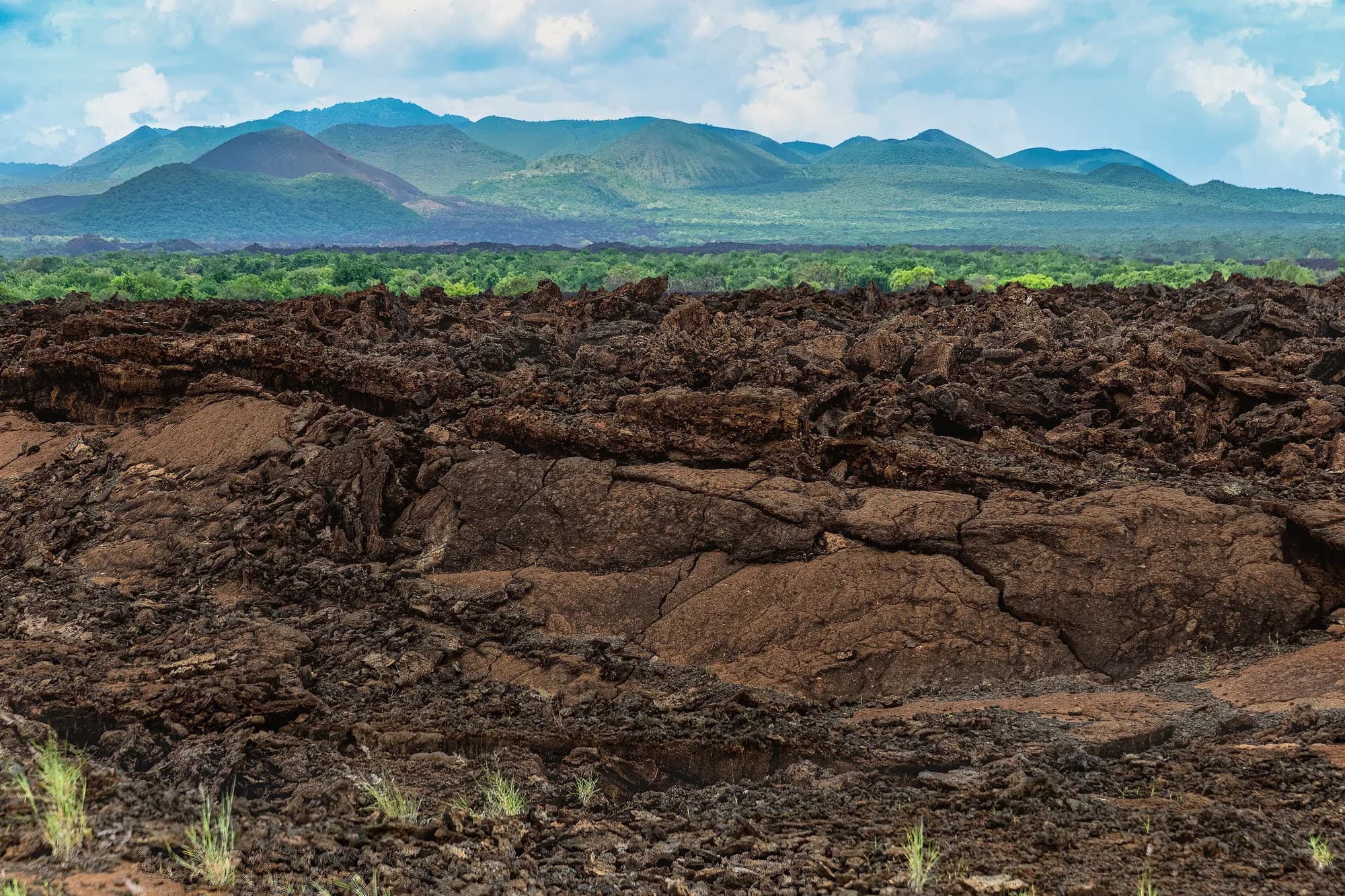
Read 28 September 2026. The factsheet names the site Tsavo West National Park, in Kenya, and gives an area of 7,327.91 square kilometres — which does not agree with the World Database on Protected Areas. It qualifies under criterion B2, and the trigger and qualifying species listed include the Near Threatened Mirafra pulpa and Crex crex, alongside Loxodonta africana (EN) and Diceros bicornis (CR). The habitat description gives Acacia-Commiphora bushland in the northern sectors, rocky outcrops, the Chyulu Hills with their ash cones and lava flows, open grassy plains in the south, riverine woodland along the Tsavo river, and extensive beds of Typha with large permanent swamps at Lake Jipe. On threats it states that the park faces no major threats at present, while listing nomadic grazing, fire suppression, invasive species, mining, drought and storms, and roads, railways and flight paths as ongoing concerns.
https://www.keybiodiversityareas.org/en/site/factsheet/6415How far ahead, and the two weeks that behave differently
Lead times
| When | Book by | Why |
|---|---|---|
| July - October | 3-6 months | Long dry season and the European summer together |
| Late November to early December | 6-12 months if Ngulia Lodge is the point | The bird-ringing fall; see below |
| Christmas and New Year | 4-6 months | The coast fills and the circuit fills with it |
| January - February | 2-4 months | Second dry window; hot, clear, good light on the hills |
| March - May | 2-6 weeks | Long rains; green, low rates, very quiet, harder viewing |
| November - December | 1-3 months | Short rains; green, patchy, often very good value |
Tsavo West carries fewer beds than Tsavo East and far more than Amboseli, and it is not a park that sells out. The pressure points are individual properties rather than the park.
The exception in the second row is genuine and is unique in Kenya. Nature Kenya records that every year since 1969 bird ringers from Europe and Kenya have met at Ngulia Safari Lodge in November and December to ring Palaearctic migrants, which fall around the lodge lights on dark misty nights. The 2024 session ran from 24 November to 6 December and ringed 13,328 birds across 118 species. If that is why you are going, you are booking a specific lodge in a specific fortnight and the park's general availability will not help you.
And if it is not why you are going
Then know that it is happening, because it is a working scientific operation with people up half the night, and the lodge in that fortnight is not the quiet place the photographs suggest. Most visitors who stumble into it find it the best thing about the trip. A few find it noisy and busy at breakfast. Either way, ask the dates before you book late November.
Nature Kenya — Ngulia bird ringing
Read 28 September 2026. Nature Kenya states that every year since 1969 bird ringers from Europe and Kenya have met at Ngulia Safari Lodge in Tsavo West to ring Palaearctic migratory songbirds, that the birds pass through in November and December, and that on dark, misty nights the migrants become disoriented and land in the bush around the lights of the lodge. It gives 597,694 Palaearctic migratory birds of 72 species and 15,570 Afrotropical birds of 234 species ringed at the site over 1969 to 2020, and for the 2020 season 10,666 Palaearctic migrants of 32 species and 588 Afrotropical birds of 75 species, ringed by the Kenyan team alone because European participants could not travel under COVID-19 restrictions.
https://naturekenya.org/2021/11/01/ngulia-bird-ringing/Nature Kenya — Bird ringing in Ngulia, January 2025
Read 28 September 2026. Nature Kenya's report on the 2024 season at Ngulia Safari Lodge, written by Aloise Garvey. It gives the dates as 24 November to 6 December 2024, a total of 13,328 birds ringed including 966 of resident species, and 118 species recorded. Named birds include migratory Eurasian Scops Owl, Corn Crakes and a rare Lesser Cuckoo, alongside residents including Narina Trogon, Eastern Nicators and African Golden Orioles.
https://naturekenya.org/2025/01/14/bird-ringing-in-ngulia/The questions that separate two quotes that look identical
- Are KWS conservation fees included, and for how many days? At USD 80 per adult per day this is the largest legitimate gap between two comparable quotes.
- Does the itinerary enter Tsavo East at any point, and if so is that second park's fee included?
- Is Amboseli in the trip? If so, ask whether they have priced the USD 150 pair or the USD 215 triple, and which, and why.
- Is Mzima Springs on the plan as a stop or as a morning, and at what time of day?
- Does the itinerary go south of the Tsavo river — Lake Jipe, the Maktau side — or stay in the northern triangle?
- What rhino access does the itinerary have, under the arrangements that exist now?
- Private vehicle or shared, how many seats, and what clearance?
Worked comparison
Two quotes for two non-resident adults, four park days in Tsavo West and two at Amboseli. Quote A is USD 250 a head cheaper and excludes park fees; quote B includes them and says it has bought the pair package. If the pair covers the whole trip, quote B's included fees are worth 2 x USD 150 = USD 300 against quote A's USD 500 payable at gates — 2 x (4 x USD 80) plus 2 x (2 x USD 90). Quote A is therefore USD 500 behind at the barrier having been USD 500 ahead on paper, and the two are level. Every day the pair covers beyond the minimum moves it further in B's favour. This is exactly why the number of days the package covers is the question to force an answer to.
Kenya Wildlife Service — Conservation Fees, October 2025 schedule
Carried from the verified fee record this site holds against KWS's own published schedule, taken from the PDF above on 27 September 2026. We tried the department again on 28 September 2026 and the read failed at the same wall: the fee PDF returned a TLS certificate that could not be verified, and so did the department's own December 2025 press release on the rhino sanctuary. The figures here are therefore carried as recorded rather than re-read live, and no operator's copy of the tariff has been substituted for the department's — an operator's fee table is not a source, however confidently it is laid out. One caveat belongs on the face of the page rather than in a footnote: the schedule bands parks rather than naming a rate park by park, and Tsavo West sits in the band printed "WILDERNESS PARKS (A)", given on the document as "Tsavo East and Tsavo West National Parks". The mapping from that band to this park is the single step between the document and these tables.
https://kws.go.ke/wp-content/uploads/2026/05/KWS-Conservation-Fee-October-2025.pdfWhat goes wrong at the booking stage
- Booking Tsavo West expecting Tsavo East's game viewing in better scenery. You get the better scenery. The game viewing is genuinely harder and no booking decision fixes that; the wildlife page says why.
- Booking one night as a stop between Amboseli and the coast, which is what most itineraries do, and seeing Mzima Springs and nothing else.
- Assuming the rhino sanctuary is the small fenced thing the guidebooks describe.
- Booking a property in the northern sector and then asking to see Lake Jipe, which is a long way south on rough ground.
- Buying the pair package without asking about the triple, when the upgrade costs USD 65 and a Tsavo East day costs USD 80.
- Arriving at Mzima at midday because it fitted the drive, when the whole point of the place is what is in the water and the light on it.
- Taking a low-clearance vehicle because the KWS seat band said it was cheaper.